


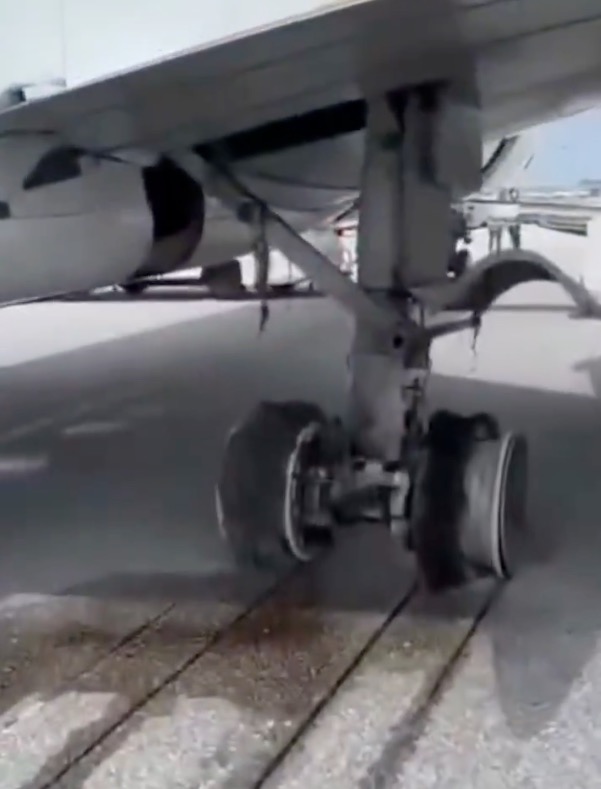
KUALA LUMPUR — In a bizarre and highly unusual coincidence, a Singapore Airlines (SIA) Boeing 737 MAX 8 operating flight SQ114 suffered a double tyre burst upon landing at Kuala Lumpur International Airport (KLIA), triggering emergency protocols and forcing multiple trailing aircraft into go-arounds.
The incident has sent shockwaves through the regional aviation community, primarily because it marks the second time in an incredibly short span that the exact same flight number, operated by the exact same aircraft type, suffered an identical landing gear failure at the same airport.
The Latest Incident: SQ114 (9V-MBN)
The most recent drama unfolded when SQ114, a scheduled short-haul flight from Singapore Changi Airport to Kuala Lumpur, touched down on KLIA’s runway. Upon rollout, both tyres on the aircraft’s landing gear burst with significant force.
- Aircraft Involved: Boeing 737 MAX 8 (Registration: 9V-MBN)
- The Aftermath: The disabled aircraft came to an immediate halt near the midpoint of the runway, completely immobilizing it.
- Emergency Response: Airport Rescue and Firefighting Services (AFRS) instantly deployed fire trucks to the scene as smoke poured from the wheel assembly.
- Air Traffic Disruption: With the aircraft blocking a primary runway, air traffic controllers were forced to order immediate go-arounds for several arriving flights, severely disrupting the airport’s sequencing.
Passengers and crew members were safely evacuated via buses to the main terminal while specialized recovery teams worked under intense pressure to inspect the landing gear and safely tow the aircraft to a remote parking bay.
Dejavu on the Tarmac: The Previous Day’s Incident
What has left aviation experts and passengers stunned is the uncanny timing of a nearly identical mishap just 24 hours prior.
The day before, the exact same flight, SQ114, also operated by a Boeing 737 MAX 8 but with registration 9V-MBA, suffered a double tyre blowout under almost identical landing conditions at KLIA. That incident similarly stranded 147 passengers and eight crew members on the tarmac, shutting down the runway for hours while ground crews cleared debris to prevent Foreign Object Damage (FOD).
“To have a double tyre burst on a heavy commercial jet is rare. To have it happen to the exact same flight number, using the same aircraft variant, at the same destination airport on consecutive days defies conventional odds,” noted an aviation safety analyst.
Investigation Underway
Singapore Airlines confirmed both incidents in separate statements, extending apologies to affected travelers and emphasizing that the safety of passengers and crew remains its topmost priority. The return leg flights (SQ113) back to Singapore had to be heavily delayed or canceled, with SIA scrambling replacement aircraft to ferry stranded passengers home.
The Civil Aviation Authority of Singapore (CAAS), Malaysia’s Air Accident Investigation Bureau (AAIB), and SIA engineering teams have launched a joint investigation. Investigators will be scrutinizing several key factors to determine if there is a systemic connection:
- Runway Conditions: Examining both Changi and Kuala Lumpur runways for hidden debris or sudden structural degradation.
- Anti-Skid Systems: Checking the braking and anti-skid software units on the 737 MAX 8 fleet.
- Batch Maintenance: Reviewing recent tyre pressure checks, wear-and-tear logs, or potential batch defects in the rubber compounds used on the regional fleet.
While tyre bursts during high-speed landings do occur periodically in commercial aviation due to hard touchdowns or heavy braking, the mirrored nature of these back-to-back incidents ensures that regulators will be inspecting Singapore Airlines’ 737 MAX 8 operations under a microscope over the coming weeks.