


The AAIB has launched a formal investigation into a “serious incident” involving a British Airways Airbus A320 approaching London Heathrow Airport.
The Airbus A320-200, registered as G-EUUN, was operating flight BA919 from Düsseldorf on July 6, 2026, when an air data system failure triggered stall warnings, requiring direct physical intervention by the captain during approach. While sensationalized media coverage has framed the event as an impending catastrophe, official safety reports point to a technical malfunction and a managed recovery under challenging conditions.
Sequence of Events
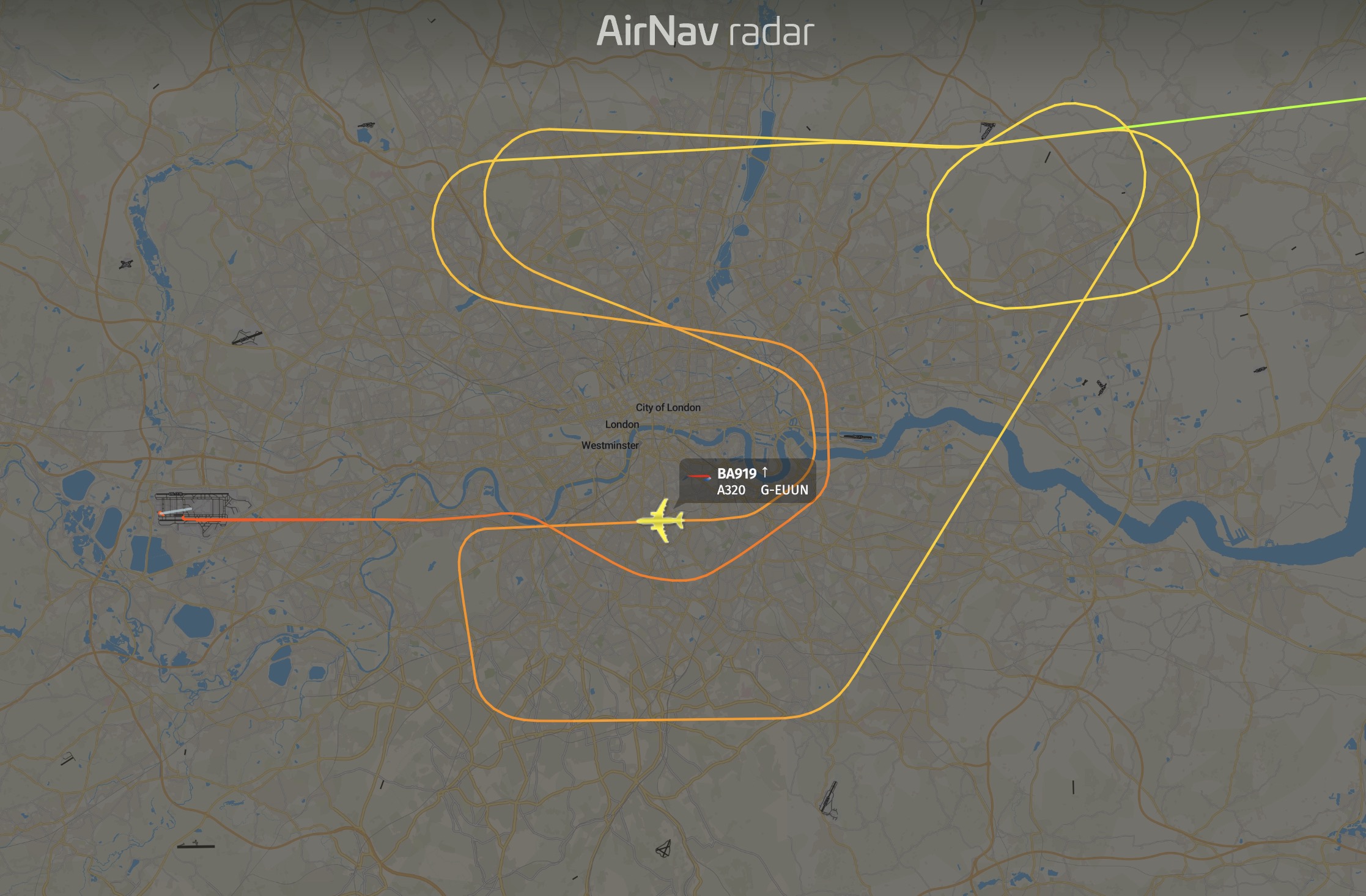
According to preliminary reporting from aviation safety authorities and flight tracking data, the incident unfolded in two distinct phases during the aircraft’s descent into Heathrow:
- Air Data Reference Failure: While descending over East London, the aircraft experienced an Air Data Reference (ADR) system failure. The ADR system supplies critical flight information, including airspeed and angle of attack, to the flight deck instruments and flight control computers.
- Control Law Reversion: The computer system detected inconsistent data and reverted from Normal Law (which provides automated flight envelope protections) to Alternate Law. In Alternate Law, several automatic protections—including built-in stall prevention—are reduced or deactivated, requiring precise manual handling by the pilots.
- First Stall Warning & Aborted Approach: A stall warning sounded during the initial approach to Runway 27L. The flight crew promptly executed a go-around/discontinued approach, declared a
PAN PANurgent situation to Air Traffic Control, and entered a holding pattern to run standard system checklists. - Second Warning & Command Override: During the subsequent approach at approximately 3,000 feet, a second stall warning triggered. As the aircraft responded to control inputs, the captain stepped in, taking direct physical control of the sidestick from the first officer to execute a recovery maneuver. The aircraft briefly descended to roughly 2,200 feet before stabilizing.
- Safe Landing: The crew upgraded their distress status to
MAYDAYto secure immediate priority handling and landed the aircraft safely at Heathrow without further incident or injury to passengers.
Technical Context: What Is a Stall Warning?
In aviation terminology, an aerodynamic stall does not mean the engines have stopped. Rather, it means the airflow over the wings has separated due to an excessive angle of attack or insufficient airspeed, reducing aerodynamic lift.
Modern airliners are equipped with synthetic or acoustic stall warnings to alert pilots long before an actual stall fully develops. However, when sensor systems (such as pitot tubes or static ports) experience corrupt data, false stall warnings can occur, confusing flight control computers and triggering cockpit alarms even if the aircraft is flying at a safe airspeed.
Key Distinction
- Normal Law: Flight computers prevent the pilot from pushing the aircraft past its structural or aerodynamic limits.
- Alternate Law: Direct flight controls return to the pilots; automatic pitch and roll protections are degraded, putting responsibility for envelope monitoring fully on the crew.
Ongoing Investigation
The AAIB has formally categorized the event as a “Loss of Control In-Flight” (LOC-I) serious incident—a standard safety classification used whenever control laws degrade or stall warnings sound low to the ground.
Investigative priority is focused on identifying why the Air Data Reference failed and examining the flight data recorder (FDR) and cockpit voice recorder (CVR) inputs to evaluate how the crew responded to the conflicting instrumentation. British Airways confirmed it is cooperating fully with safety regulators.
According to The Sun, the captain is now understood to be grounded on “stress leave”.