

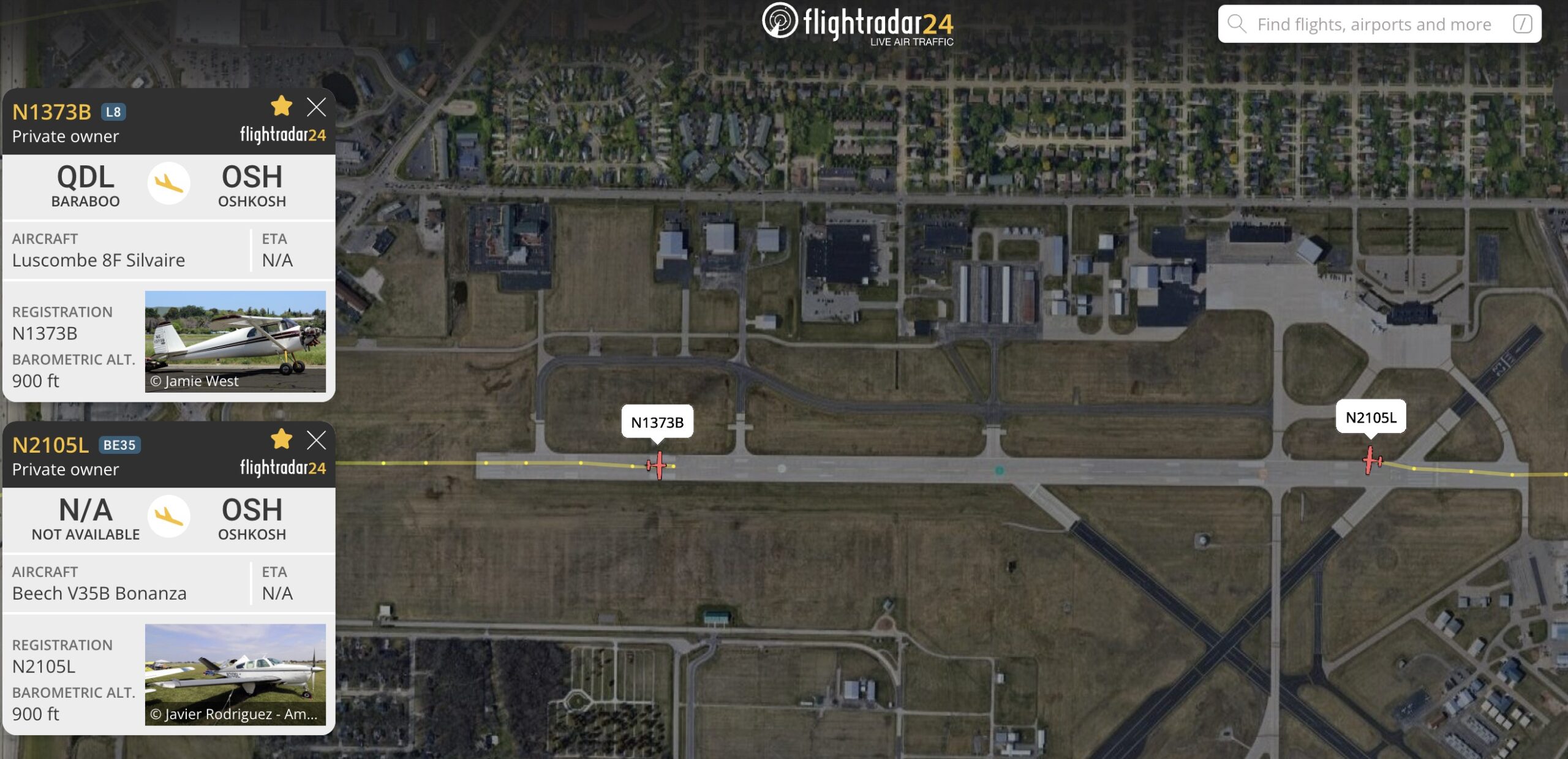
OSHKOSH, Wis. — Quick action by an air traffic controller prevented a potential disaster at Wittman Regional Airport (OSH) during the annual EAA AirVenture fly-in, after a general aviation aircraft attempted to land in the wrong direction on an active runway—directly toward another plane on short final approach.
The incident unfolded amidst the heavy, fast-paced air traffic that transforms Oshkosh into the world’s busiest control tower every summer.
Head-to-Head on Runway 09/27
According to flight tracking data and Air Traffic Control (ATC) audio, an aircraft registered N2105L was on short final approach to land on Runway 27. At the exact same time, a second aircraft, registered N1373B, began an unauthorized approach to land on Runway 09—the exact same strip of tarmac, but flying in the opposite direction.
Complicating matters further, the pilot of the incoming N1373B was not in radio contact with the control tower, creating a dangerous blind spot in the high-density airspace.
“He Is Not Talking To Us”
Spotting the rogue aircraft closing in head-on, the tower controller immediately issued an urgent instruction to the pilot of N2105L to abort the landing and maneuver out of harm’s way:
“Aircraft on short final, go around, offset to the right! There is opposite traffic coming—he is not talking to us, he is landing in the opposite direction!”
The pilot of N2105L acted instantly, applying engine power and sidestepping to the right of the runway centerline to clear the path of the oncoming plane.
Once safe separation was established and the pilot completed the evasive maneuver, the controller offered immediate praise over the frequency:
You’re doing a good job.”
High-Density Airspace Challenges
EAA AirVenture in Oshkosh sees over 10,000 aircraft land across a single week, requiring specialized ATC arrival procedures (NOTAMs) that rely heavily on precise pilot discipline, visual spotting, and strict radio protocols.
While non-towered or non-radio communication errors occasionally happen in general aviation, a head-on runway approach in controlled, hyper-congested airspace is exceptionally rare. Thanks to the vigilant eye of the Oshkosh controller and the quick reflexes of the pilot on final, what could have been a catastrophic collision ended as a textbook execution of emergency procedures.
The Federal Aviation Administration (FAA) routinely reviews airspace incursions and communication losses during the event to ensure procedure adherence and maintain safety standards.