

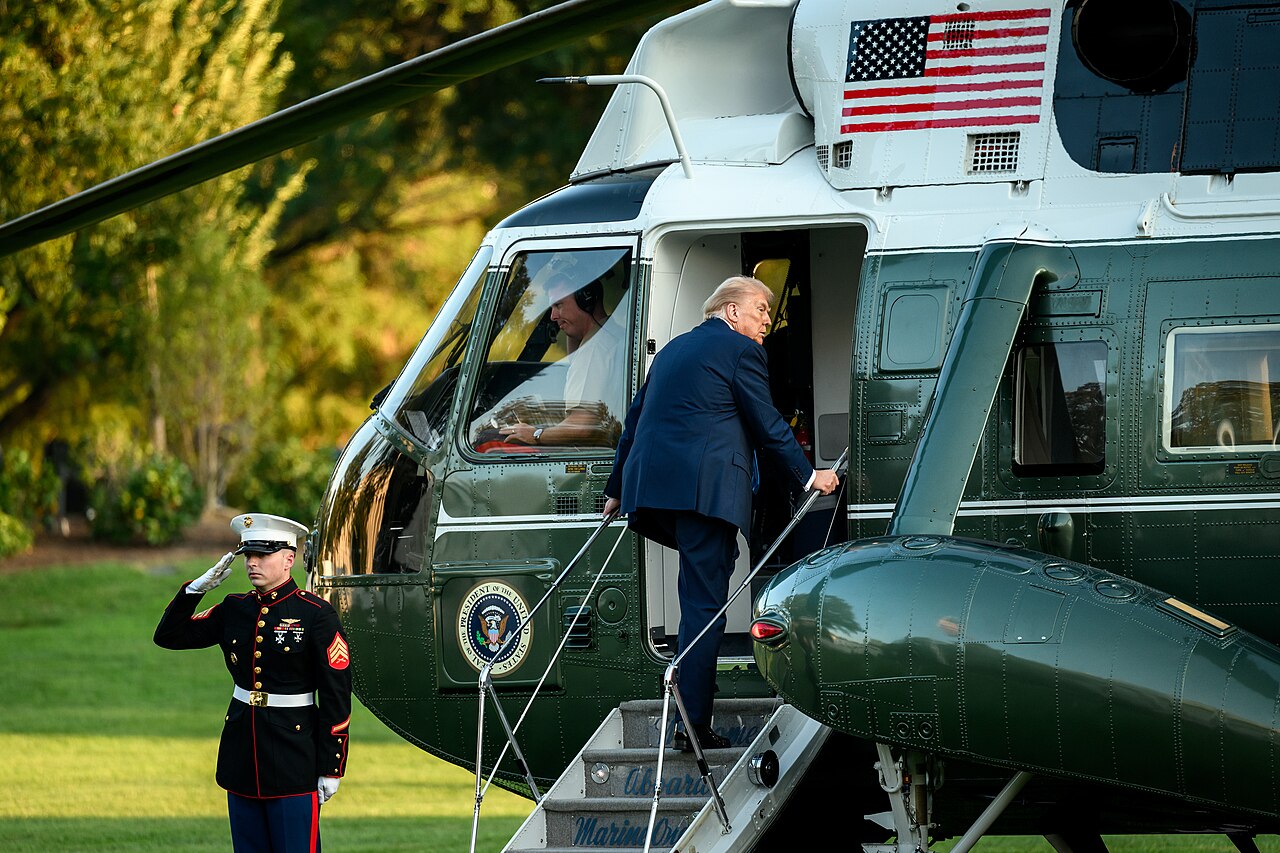
WASHINGTON — August 5, 2026 — Federal aviation authorities and safety officials have opened an investigation into a momentary loss of separation between Marine One, carrying President Donald Trump, and a commercial regional airliner departing Ronald Reagan Washington National Airport (DCA) on Tuesday afternoon.
The National Transportation Safety Board (NTSB) and the Federal Aviation Administration (FAA) confirmed they are reviewing the August 4 event, in which required airspace distance minimums were compromised shortly after the presidential helicopter lifted off from the White House.
What Happened on August 4
According to flight records and aviation officials:
- 2:33 p.m. EDT: Marine One departed the Ellipse near the White House, heading toward Joint Base Andrews in Maryland ahead of President Trump’s scheduled flight to Los Angeles.
- 2:34 p.m. EDT: Envoy Air Flight 3742—an Embraer E170 bound for Pensacola, Florida—was cleared for takeoff and lifted off from Runway 19 at DCA.
- Loss of Separation: Standard federal regulations require a minimum distance of 1.5 miles horizontally and 500 feet vertically between aircraft operating in controlled airport airspace. Preliminary flight tracking indicates the jet and the presidential helicopter came closer than those parameters allowed as the airliner climbed above the helicopter’s altitude.
- Go-Around Issued: Out of precaution, air traffic control instructed another arriving regional flight—Republic Airways Flight 4700—to initiate a go-around roughly three miles from DCA until the surrounding airspace cleared.
Both Marine One and the commercial jet reached their respective destinations safely and without further incident.
Heightened Scrutiny Following 2025 Airspace Rules
The investigation focuses heavily on why commercial departures at Reagan National were not paused while Marine One was active in the immediately adjacent corridor.
The FAA instituted stricter operational protocols mandating temporary ground holds at DCA during presidential helicopter movements following the fatal January 2025 mid-air collision between a U.S. Army Black Hawk and an American Airlines regional jet over the Potomac River.
Official Responses
“Based on our preliminary safety review, there was a momentary loss of separation after which the aircraft continued to move away from one another. The air traffic controller was in contact with both the commercial pilot and Marine One pilot throughout.” — Federal Aviation Administration (FAA)
“Marine One flights are piloted by some of the best aviators in the world, and at no point was the President in harm’s way.” — Kush Desai, White House Spokesperson
A Marine Corps spokesperson added that the helicopter crew received timely traffic advisories from local controllers and did not execute emergency evasive maneuvers, confirming that the flight paths were non-converging throughout the sequence.
The FAA plans to convene a dedicated Safety Review Team to evaluate air traffic control procedures and determine why procedural holds were not triggered.