

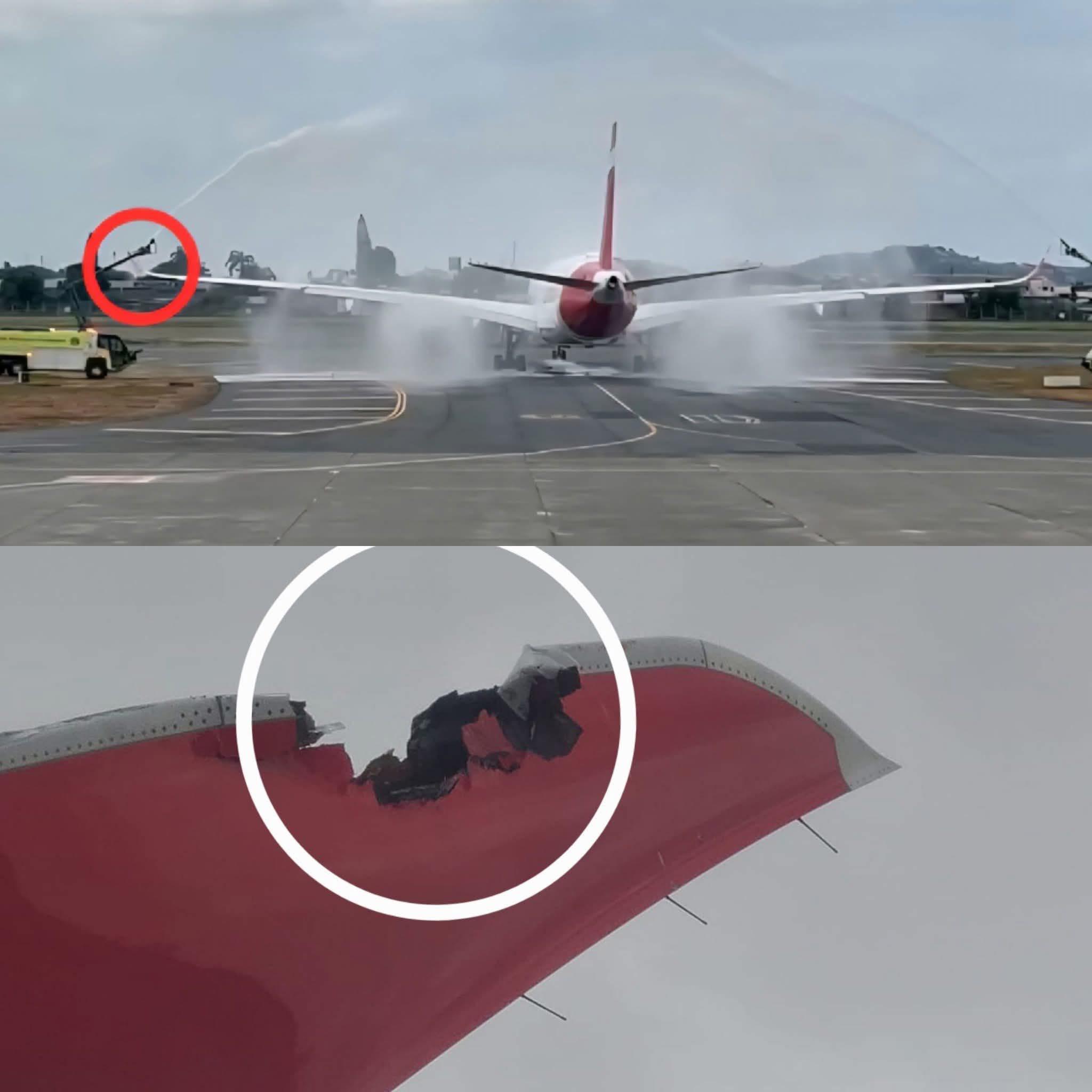
GUAYAQUIL, Ecuador — A celebration welcoming Iberia’s flagship widebody aircraft to José Joaquín de Olmedo International Airport went off script when the plane collided with an airport fire truck during a ceremonial water cannon salute.
The incident involved an Airbus A350-900, registered as EC-NXD, which had just arrived in Guayaquil. The flight was a milestone event for the airport, marking the inaugural deployment of Iberia’s newer, larger A350 aircraft on the route connecting Guayaquil and Madrid, which is typically serviced by older Airbus A330s.
To celebrate the high-profile upgrade, local airport authorities organized a traditional water salute. The ceremony involves airport fire tenders parking along the taxiway margins to spray a massive arch of water over the arriving aircraft as a gesture of welcome.
However, as the advanced widebody jet taxied through the spray, its left wingtip struck one of the stationary fire department vehicles. Footage and photos shared on aviation forums show that while the aircraft appeared to stay perfectly centered on the taxiway line, the fire truck had been positioned too close to the active taxiway safety strip, failing to account for the A350’s sweeping 212-foot (64.75-meter) wingspan.
The impact caused significant damage to the aircraft’s curved composite winglet, tearing a deep gash into the structure.
Fortunately, no injuries were reported among the passengers, flight crew, or ground team. The aircraft was able to taxi to the gate under its own power, where passengers deplaned normally. However, the return flight to Madrid (IB132) had to be canceled, leaving the brand-new aircraft grounded in Ecuador while technicians assessed the structural integrity of the wingtip and arranged for replacement parts to be flown in.
The mishap has once again sparked discussion within the aviation industry about the necessity of water cannon salutes. While the practice is a long-standing tradition for inaugural flights, critics point out that parking heavy emergency vehicles within the tight clearance margins of modern commercial aircraft introduces an avoidable risk of ground collisions.
An official investigation has been launched by local aviation authorities to determine the breakdown in communication and spatial planning that led to the incident.