

CARACAS, Venezuela — Venezuela’s primary international gateway, Simón Bolívar International Airport, has been forced into an indefinite closure after a violent “doublet” of back-to-back earthquakes heavily damaged its main terminals on Wednesday evening.
The twin tremors—a powerful magnitude 7.2 foreshock followed less than 40 seconds later by a massive 7.5 magnitude mainshock—struck northwestern Venezuela near the coastal town of Morón. Felt as far away as Colombia and northern Brazil, the quakes are among the strongest to hit the country in more than a century, leaving a trail of collapsed buildings and catastrophic infrastructure failure across the capital region of Caracas.
Panic inside the Terminal
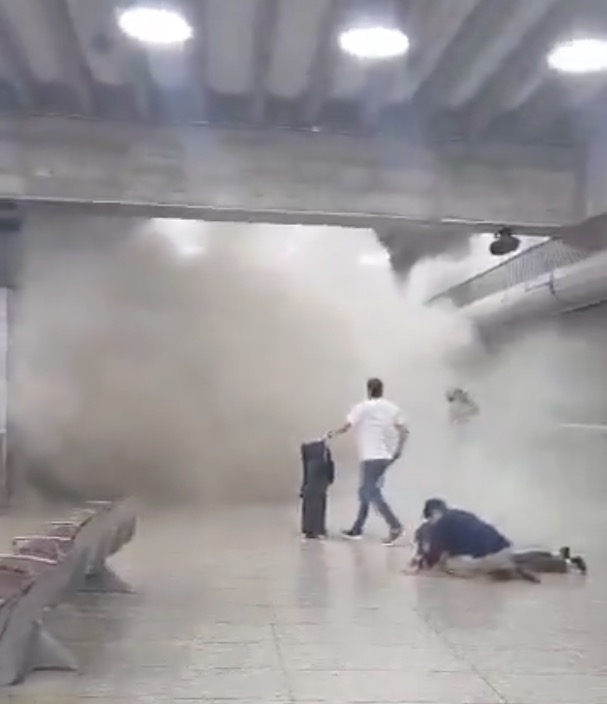
At the airport, located in Maiquetía, La Guaira, just north of Caracas, the late-afternoon rush turned into a scene of pure survival. Terrified travelers screamed and scrambled for exits as the ground buckled violently.
Videos capturing the terrifying moment circulated rapidly on social media:
- Ceiling Collapses: Large sections of heavy suspended ceiling grids, overhead light fixtures, and electrical wiring tore loose, crashing onto seating areas, check-in counters, and commercial walkways.
- Total Blackouts: Flight information display boards swung wildly over the crowds before the main power lines failed completely, plunging the heavily damaged passenger terminals into darkness.
- Widespread Debris: Rubble, dust, and shattered glass littered the landside and airside processing zones as passengers and airport workers blindly navigated toward open-air tarmac zones to escape falling debris.
Air Connectivity Indefinitely Frozen
In a late-night national address, acting President Delcy Rodríguez confirmed that Simón Bolívar International Airport had sustained severe structural damage and would remain completely closed to all arriving and departing flights while comprehensive safety evaluations take place.
While authorities have yet to confirm if the runways, taxiways, or the air traffic control tower suffered similar damage, the devastation to passenger infrastructure alone makes operations impossible. Post-earthquake protocols require complete inspections of passenger screening areas, fuel lines, baggage handling facilities, and backup power grids before any commercial traffic can resume.
The abrupt closure deals a crushing blow to Venezuela’s aviation sector. The airport had only recently begun a fragile recovery following years of economic isolation, celebrating the high-profile return of major international airlines—including American Airlines, United Airlines, and Avianca—to its runways earlier this year.
Widespread Destruction and Rescue Operations
Beyond the tarmac, the twin quakes have paralyzed northern Venezuela. Interior Minister Diosdado Cabello reported an “alarming situation” in Caracas, where multiple high-rise apartment complexes and businesses completely pancaked or suffered severe structural failures, particularly in the Chacao and Altamira neighborhoods.
VENEZUELA DOUBLET EARTHQUAKE PROFILE (USGS)
--------------------------------------------------
Foreshock:   Magnitude 7.2  | Depth: 21.9 km
Mainshock:   Magnitude 7.5  | Depth: 10.0 km (39 seconds later)
Epicenter:   Veroes Municipality, Yaracuy State
Emergency crews, military personnel, and civilian volunteers are actively digging through piles of concrete rubble in a desperate race against time to rescue survivors. In the neighboring state of Falcón, local officials confirmed dozens of hospitalizations, with at least 15 people known to be trapped beneath fallen structures.
As a safety precaution against secondary disasters, the government has shut off the main gas supply to major metropolitan areas to prevent explosions, suspended the Caracas Metro transit system, and ordered all schools closed. With communication lines fractured and aftershocks continuing to rattle the region, local officials are urging citizens to sleep outside and clear the roads so emergency vehicles can access the hardest-hit zones.