

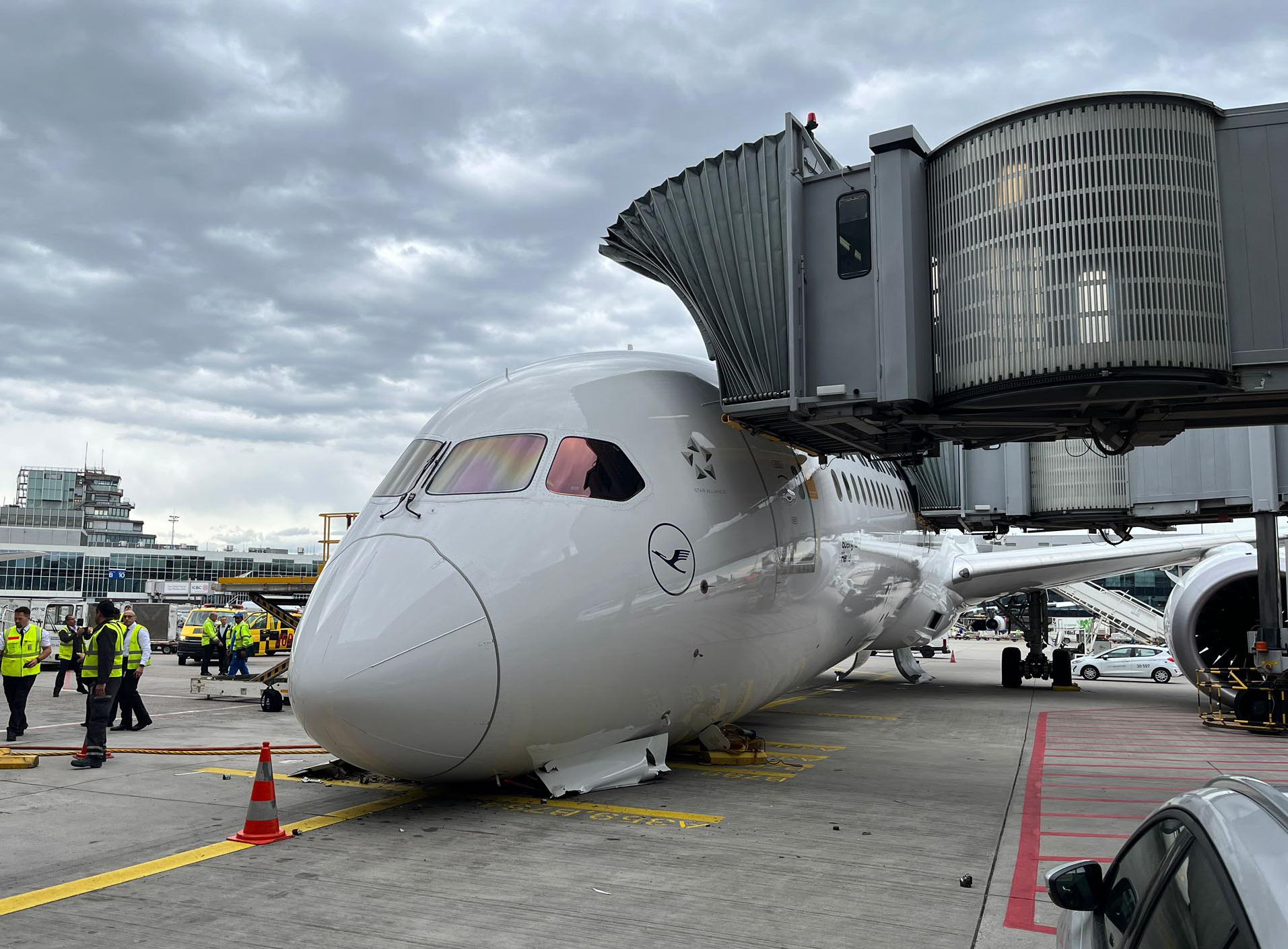
FRANKFURT, Germany — A Lufthansa Boeing 787-9 Dreamliner suffered a nose landing gear collapse on the tarmac at Frankfurt Airport (FRA) on Thursday, causing a stir at one of Europe’s busiest aviation hubs.
The aircraft, registered as D-ABPQ, was parked at the gate when the incident occurred. Fortunately, airport officials and Lufthansa have confirmed that no serious injuries were reported.
Incident Details at the Gate
The twin-engine widebody aircraft had completed flight LH469 from Austin and was stationary at its designated gate when the forward landing gear unexpectedly retracted.
Photos emerging from the scene show the nose of the multi-million-dollar jet resting directly on the tarmac, with the forward fuselage sustaining visible ground-contact damage. Passenger boarding bridges and ground support equipment were immediately backed away as airport emergency services rushed to secure the area.
What Causes a Nose Gear Collapse?
While a full investigation is underway, aviation experts note that nose gear collapses on the ground typically stem from a few known variables:
- Mechanical or Hydraulic Failure: A malfunction within the locking mechanisms that keep the gear extended while unpressurized.
- Accidental Human Error: The inadvertent cycling or disruption of the landing gear lever or ground-lock pins during routine maintenance or turnaround checks.
- Structural Fatigue: Though less likely for this specific airframe, wear and tear on the gear assembly can lead to sudden failure.
D-ABPQ is a relatively new addition to Lufthansa’s long-haul fleet, making a structural fatigue issue highly improbable.
Impact on Operations
Lufthansa has grounded the aircraft indefinitely to assess the structural integrity of the lower forward fuselage and the nose wheel well.
A spokesperson for the airline stated: “We are working closely with airport authorities and maintenance teams to determine the exact cause of the incident. The safety of our staff and passengers remains our highest priority.”
Frankfurt Airport reported minor disruptions to adjacent gates, but overall flight schedules remained largely unaffected. The German Federal Bureau of Aircraft Accident Investigation (BFU) is expected to launch an inquiry into the mechanical and procedural chain of events leading up to the collapse.
Status Update: At the time of the collapse, the aircraft was not actively boarding passengers, preventing what could have been a much more chaotic scene. A minimal crew and ground staff were in the vicinity, but everyone escaped without major injury.