
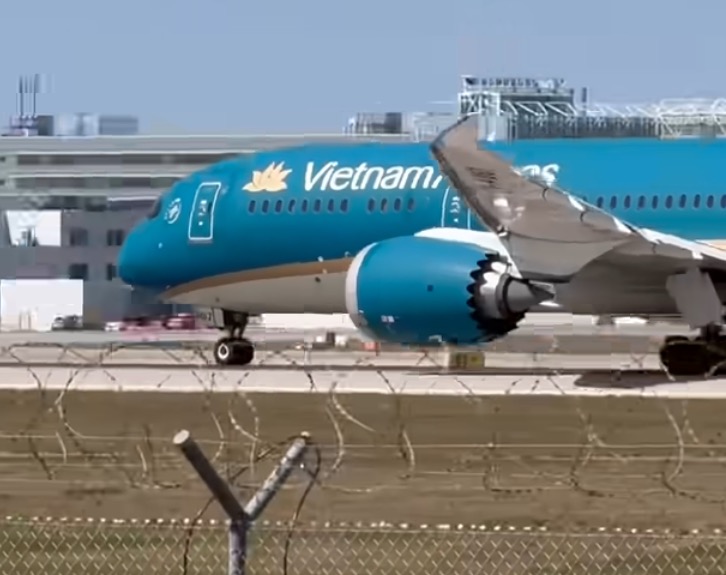
GERMANY — Investigators in Germany are examining a dramatic runway excursion involving a Vietnam Airlines Boeing 787-9 Dreamliner that struck runway equipment and suffered severe fuselage damage during a botched takeoff attempt at Munich Airport.
According to preliminary findings released by the German Federal Bureau of Aircraft Accident Investigation (BFU), flight recorder data revealed that braking commands were applied while the 240-tonne widebody aircraft was actively accelerating down the runway.
Braking During Acceleration
The aircraft, operating as a flight to Hanoi with 271 passengers and 16 crew members aboard, commenced its takeoff roll on Munich’s Runway 08R weighing 240.9 tonnes. Calculated takeoff speeds for the departure were set at a decision speed (V1) of 169 knots, rotation speed (Vr) of 175 knots, and safety speed (V2) of 180 knots.
Data retrieved from the Enhanced Airborne Flight Recorder (EAFR) shows that at 11:56:15 UTC, just seconds after Takeoff/Go-Around (TOGA) power was selected—rudder pedal inputs were accompanied by movement on both left-seat brake pedals.
Despite repeated braking commands registered by both the left and right Brake System Control Units (BSCUs), the Dreamliner continued its takeoff roll. Pressure peaked nearly a minute later, with the left BSCU recording up to 27% brake command and the right reaching 17%. The maximum recorded brake-pedal deflection reached 7.2 degrees out of a maximum 12.5 degrees.
Premature Lift-Off and Impact
With the brakes dragging against the accelerating aircraft, the pilot monitoring manually pushed thrust levels from 100% to 101% N1 to compensate.
Seconds later, at 11:57:14 UTC, the flight crew initiated rotation at 163 knots, a full 12 knots below the calculated Vr speed of 175 knots, near the far end of the runway threshold.
Unable to generate sufficient lift on the paved surface, the 787-9 ran out of runway and lifted off from the grass strip beyond the end of Runway 08R. During the low-speed rotation and off-runway excursion, the aircraft’s tail and main landing gear collided with the runway approach-lighting system, destroying 20 light fixtures.
| Parameter | Planned / Required | Actual Recorded |
| Gross Weight | 240.9 tonnes | 240.9 tonnes |
| Rotation Speed ($V_r$) | 175 knots | 163 knots (12 kt premature) |
| Max Brake Deflection | 0.0° | 7.2° (out of 12.5°) |
| Lift-Off Point | Paved Runway 08R | Grass surface beyond threshold |
Airborne Stall Warning and Emergency Return
The consequences of the premature rotation became immediate as the heavy jet struggled into the air. At 11:57:21 UTC, seven seconds after rotation, the aircraft’s automated stall-protection system triggered, automatically deploying the leading-edge slats to avert an aerodynamic stall.
The crew reapplied TOGA thrust a second later. The target V2 speed of 180 knots was not attained until the aircraft reached a radio altitude of 76 feet, after which the crew raised the landing gear and established a climb.
Realizing the severity of the tailstrike and suspecting damaged tires, the flight crew declared an emergency. After jettisoning approximately 62 tonnes of fuel to reduce landing weight, the Dreamliner returned safely to Munich Airport. None of the 287 passengers and crew onboard were injured.
Post-landing inspections revealed severe tailstrike damage to the lower rear fuselage alongside structural scarring from contact with the light stanchions. All four main gear tires on the left bogie were found destroyed.
Investigation Ongoing
The BFU has impounded both Brake System Control Units and the aircraft’s Electric Brake Actuator Controllers for forensic analysis to determine whether the braking inputs resulted from mechanical malfunction, electronic control fault, or unintentional pilot foot pressure on the upper pedal surfaces during rudder adjustments.
“The preliminary data paints a remarkable picture,” the investigative report noted, emphasizing that the underlying cause for the simultaneous takeoff acceleration and braking commands remains under active investigation.