


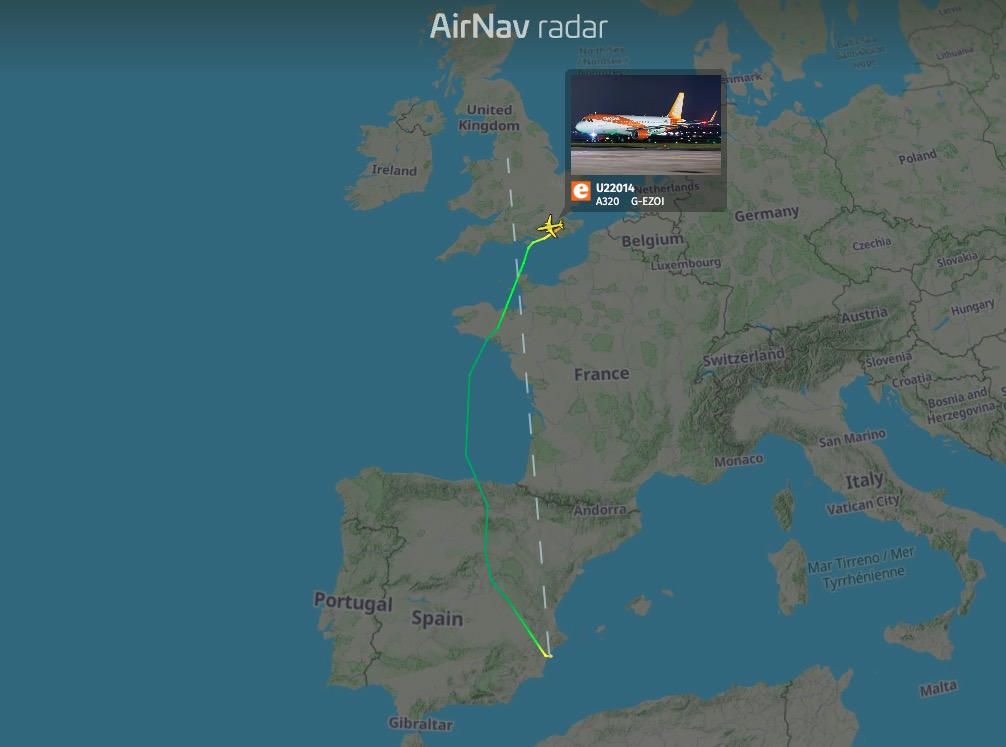
An easyJet flight bound for Manchester was forced to make an emergency diversion to London Gatwick Airport on Saturday following a loss of hydraulic fluid mid-flight.
Flight U22014, operated by an Airbus A320-214 (registration G-EZOI), departed Alicante–Elche Miguel Hernández Airport (ALC) in Spain at 09:10 UTC. The aircraft climbed to its cruising altitude of 34,000 feet, routing over northern Spain and along the Atlantic coast of France toward the United Kingdom.
Roughly 90 minutes into the flight, the crew detected a technical failure involving the aircraft’s Yellow Hydraulic System. In response, the flight crew broadcasted an emergency via transponder code Squawk 7700 and redirected the aircraft toward London airspace, requesting an immediate diversion to London Gatwick (LGW).
Because a loss of hydraulic fluid can affect nose-wheel steering or braking efficiency after touchdown, the airline advised air traffic control of potential runway blockages if the aircraft could not taxi under its own power, noting alternative diversions to London Luton or Stansted if required.
Flight U22014 touched down safely on Runway 26L at Gatwick at 11:34 UTC, just ahead of its estimated arrival time. Emergency response vehicles met the twin-engine jet on the taxiway immediately after it cleared the active runway. Following an exterior safety inspection by airport fire services, the aircraft was cleared to taxi to a remote stand under its own power.
easyJet confirmed the diversion was executed due to a technical issue and stated that a replacement aircraft was arranged to transport passengers onward to Manchester.
Understanding the Airbus A320 “Yellow” Hydraulic Circuit
The Airbus A320 family relies on three independent, continuously pressurized hydraulic systems—color-coded as Green, Blue, and Yellow operating at a nominal pressure of 3,000 psi. This multi-system redundancy ensures that if one system fails, the remaining systems maintain control of primary flight surfaces, landing gear, and brakes.
What Happens When Yellow Fluid Is Lost?
A total loss of Yellow hydraulic fluid disables the systems exclusively dependent on it. While the aircraft remains fully controllable using the Green and Blue systems, pilots must prepare for specific operational limitations during landing:
- Braking Changes: The primary braking system (powered by the Green circuit) remains active, but alternate braking and the parking brake lose functionality.
- Taxiing & Steering: Depending on aircraft model configuration, nose-wheel steering may be restricted or lost upon rollout, requiring ground tug assistance to clear the runway safely.
- Control Surface Degradation: Spoilers powered by the Yellow system become unavailable, slightly increasing the landing roll distance required.