

KYIV — In a historic escalation of long-range aerial warfare, Ukrainian forces have successfully executed their deepest autonomous drone strike of the war, penetrating more than 2,500 kilometers (1,550 miles) into Russian airspace to strike the country’s largest oil refining facility in Omsk, Siberia.
The successful operation marks an unprecedented milestone in the operational range of low-cost, long-range uncrewed aerial vehicles (UAVs), proving that Ukraine can project precision kinetic airpower well beyond European Russia into Western Siberia.
Breaking the 2,500-Kilometer Barrier
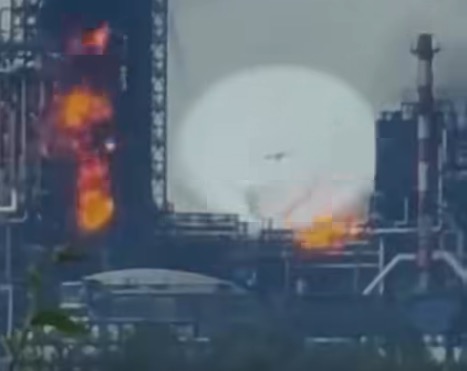
According to Ukrainian defense officials, multiple strike drones successfully traversed heavily contested airspace to target the Omsk facility. Local footage captured by residents in Siberia showed the distinctive acoustic signature of low-RPM piston engines immediately prior to detonation, followed by thick plumes of black smoke billowing from the refinery’s primary distillation columns.
For aviation and defense analysts, the 2,500-kilometer mission profile represents a massive evolutionary leap forward in small-aircraft navigation, aerodynamic efficiency, and fuel management. Flying a drone at that distance requires:
- Advanced Fuel Economy: Utilizing highly efficient, low-consumption gasoline engines matched with high-aspect-ratio wings to maximize lift-to-drag ratios.
- Resilient Navigation Systems: Evading intense Russian electronic warfare (EW) and GPS-jamming corridors by relying on alternative navigation systems like terrain contour matching (TERCOM) or visual odometry.
- Low-Altitude Flight Paths: Hugging the terrain to exploit gaps in radar coverage over vast expanses of the Russian interior.
Air Defense Saturation and Systemic Gaps
The strike exposes glaring systemic vulnerabilities within the Russian aerospace defense network. Over the past few months, the Russian Ministry of Defense has attempted to mitigate the threat by re-allocating scarce surface-to-air missile (SAM) systems—such as the Pantsir-S1 and S-400—to high-value industrial targets, alongside organizing mobile fire groups equipped with searchlights and heavy machine guns.
However, the immense geographic footprint of Russia’s industrial base makes comprehensive point-defense functionally impossible.
“Russia’s air defense grid is profoundly overstretched,” noted a senior Western defense intelligence expert. “They are forced to choose between shielding frontline tactical assets or protecting strategic infrastructure thousands of miles away. Ukraine is systematically exploiting these gaps.”
Strategic and Economic Fallout
The intensification of Ukraine’s asymmetric air campaign, which began accelerating significantly in March 2026, has fundamentally altered the economic landscape of the conflict. By shifting focus to high-value infrastructure deep in the Russian rear, Ukraine has achieved disproportionate strategic effects with relatively inexpensive assets.
As Kyiv continues to scale production of its long-range composite strike drones, the airspace over Russia’s deep interior can no longer be considered a safe haven. The Omsk raid signals to military planners that the boundaries of modern robotic air power have permanently expanded.