


A newly released preliminary report from the National Transportation Safety Board (NTSB) details the final seconds before a United Airlines Boeing 767 struck a light pole on the New Jersey Turnpike during its approach to Newark Liberty International Airport on May 3, 2026.
While the aircraft landed and taxied to the gate safely, debris from the shattered light pole struck a tractor-trailer traveling southbound on the highway.
What Happened in the Cockpit
According to the NTSB, the captain intentionally flew lower than the standard approach angle, a decision that was apparently not communicated to the co-pilot.
- The Intentional Low Approach: The captain told investigators he expected to fly the final segment at “3 red and 1 white” on the runway’s Precision Approach Path Indicator (PAPI).
- The Hazard: A standard, safe glide path shows 2 red and 2 white lights. A “3 red” reading indicates the aircraft is dangerously below the standard 3-degree slope.
- Lack of Communication: The cockpit voice recorder showed no discussion of this non-standard plan between the captain and the first officer.
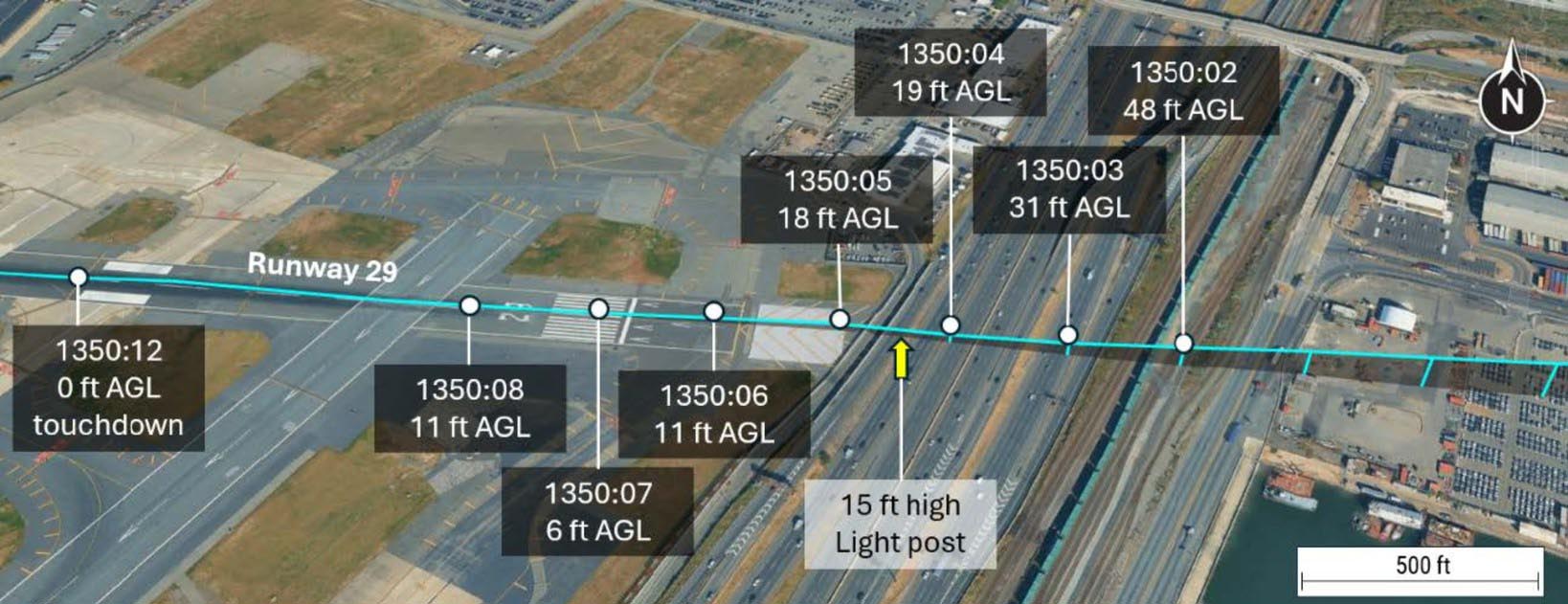
The Final Seconds Before Impact
As the aircraft descended toward Runway 29, its airspeed began to drop rapidly, triggering a series of warnings from the first officer:
- “Airspeed slow” on short final.
- “Hey you are slow.”
- “You are still slow and a little low.”
By the time the first officer looked outside and realized the severity of the situation, the plane was already touching down, leaving no time to call for a go-around.
Damage and Aftermath
The elevated New Jersey Turnpike sits roughly 5 feet higher than the runway. The captain reported hearing a “thump” just before touchdown, while flight attendants in the back of the cabin reported a loud bang.
Inspection Findings: Investigators later discovered three punctures along the aircraft’s lower left rear fuselage, with the largest gash measuring 46 inches long and 4 inches wide.
In response to the incident, United Airlines issued Pilot Bulletin 26-069 revision 1. The bulletin warns crews against “ducking under”, a hazardous practice where pilots intentionally shift their aimpoint below electronic or visual glide path indicators during visual approaches.