

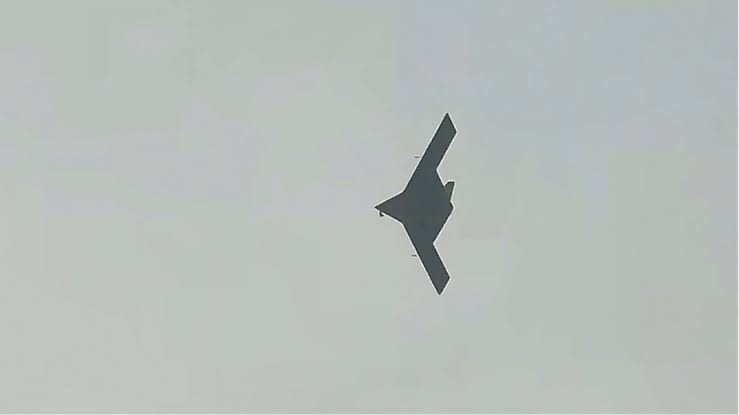
A recent incident over Chinese airspace has raised alarms among aviation security experts after a military aircraft—believed to be a drone—successfully broadcast a signal identifying itself as a Royal Air Force (RAF) Eurofighter Typhoon fighter jet.
The event, which occurred around November 20, 2025, near Hainan Island, China, exposed a critical security flaw in the widely used civilian flight tracking system, Automatic Dependent Surveillance–Broadcast (ADS-B).
Drone Mimics RAF Fighter Jet
Flight tracking services, including Flightradar24, detected an aircraft broadcasting the distinct identification code and registration of a British military platform, specifically an RAF Typhoon with the registration ZK334 and the callsign YILO2400.
However, analysts noted that the track’s behavior was entirely inconsistent with a high-performance fighter jet. The aircraft displayed a slow, stable speed and altitude pattern—characteristics typically associated with a Medium-Altitude Long-Endurance (MALE) surveillance drone—while flying in a routine pattern near Chinese airspace before ultimately landing in an area on Hainan Island known for Chinese military drone activity.
The striking discrepancy led experts to conclude that a Chinese platform was deliberately broadcasting a foreign military identity it was not authorized to use.
The ADS-B Security Flaw
The incident highlights a long-standing vulnerability in the ADS-B system, which is mandatory for most commercial and private aircraft globally.
ADS-B works by having aircraft continually broadcast their position, speed, and identifying information (like registration and flight number) to ground stations and other aircraft. However, the system lacks a built-in authentication mechanism. This allows any platform with a manually configurable transponder to spoof, or falsify, its identity, leading to potential confusion and security risks in contested or sensitive airspaces.
While the intent behind the choice of a British Typhoon code remains uncertain—whether it was a deliberate test of identity manipulation, a misconfigured transponder, or an attempt to obscure the drone’s true movements—the episode serves as a powerful reminder for military and civilian air traffic control to treat ADS-B data with caution in high-stakes operational environments.