
MILDENHALL, UK – A rare United States Air Force Boeing WC-135R Constant Phoenix, specialized for atmospheric collection and known as the “nuke sniffer,” made a safe emergency landing at RAF Mildenhall on Tuesday morning after a mission over Northern Europe was cut short.
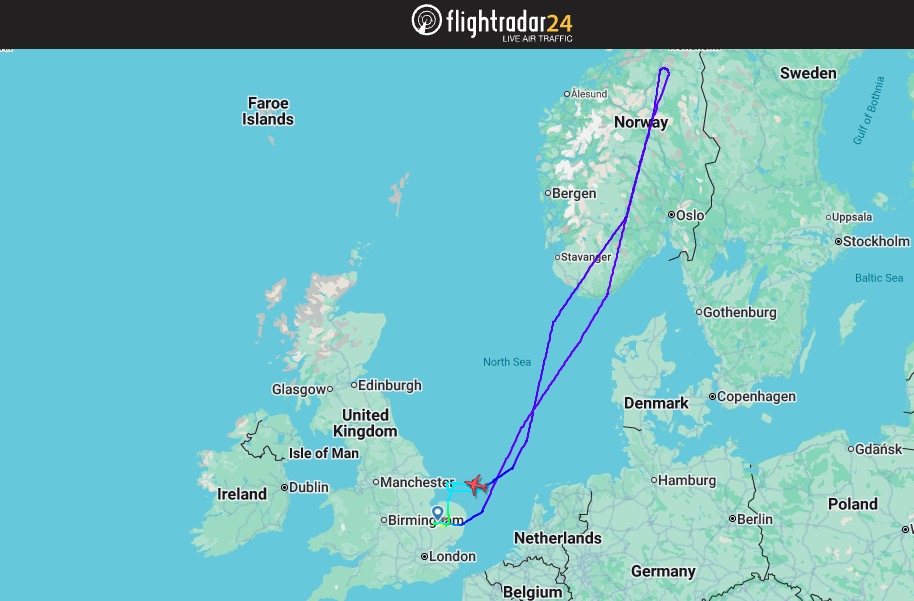
The 61-year-old aircraft (registration 64-14831) was first detected on tracking website at 04:36 UTC at the Suffolk air base. According to flight data from Flightradar24, the aircraft took off at 07:20 UTC and ascended to a cruising altitude of 33,000 feet over the North Sea. It spent several hours patrolling the skies over Norway—a region often monitored for atmospheric changes—before abruptly turning back toward the United Kingdom.
Mid-Air Emergency
The situation escalated at 11:10 UTC when the crew declared an emergency. After descending to 13,000 feet, the aircraft performed a series of holding patterns to the east of the air base, likely to burn off fuel or conduct checklist procedures for a technical issue.
The “Sniffer” touched down safely at RAF Mildenhall at 11:48 UTC, where it was met by ground crews. No injuries were reported, and the specific nature of the emergency has not yet been disclosed by the U.S. Air Force.
What is “The Sniffer”?
The WC-135R Constant Phoenix is one of the most specialized assets in the U.S. military inventory. While it looks like a standard Boeing 707-style tanker from a distance, its mission is far more clandestine.
Key Roles and Capabilities:
- Nuclear Detection: Its primary job is to “sniff” the atmosphere for radioactive particulates and gaseous debris. It is the only aircraft in the U.S. fleet capable of detecting radioactive “clouds” in real-time.
- Treaty Verification: It supports the Limited Nuclear Test Ban Treaty of 1963, ensuring that no nation is conducting illegal above-ground nuclear tests.
- Disaster Monitoring: Historically, the WC-135 fleet played a vital role in tracking radiation leaks from disasters such as Chernobyl in 1986 and Fukushima in 2011.
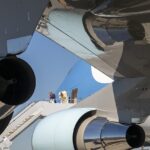
- Advanced Equipment: The aircraft is equipped with external flow-through devices that catch particles on filter paper and a compressor system that stores “whole air” samples in high-pressure spheres for later laboratory analysis.
A Modernized Veteran
The aircraft involved in today’s incident, 64-14831, is one of three recently modernized “R” variants. Though the airframe itself dates back to the early 1960s, it was recently converted from a KC-135R tanker to replace aging “C” and “W” models. These upgrades included more powerful, fuel-efficient CFM-56 turbofan engines, which are visible in the aircraft’s distinctive profile.
The presence of the Constant Phoenix in Europe is often a point of interest for aviation enthusiasts and geopolitical analysts alike, as its deployments frequently coincide with heightened tensions or specific atmospheric monitoring needs in the region.