

BISHKEK and MANILA — Aviation authorities are investigating two separate, serious ground incidents that occurred less than 24 hours apart at major Asian international airports. While both events resulted in structural damage to the aircraft involved, officials confirmed that no passengers or crew members sustained serious injuries.
Gear Collapse Halts Takeoff in Bishkek
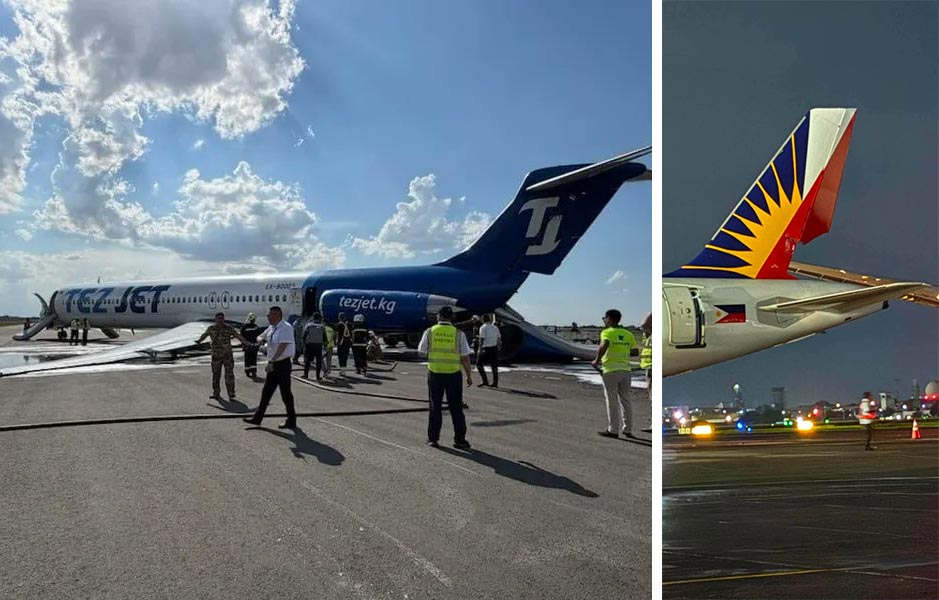
At Manas International Airport in Kyrgyzstan, a domestic flight turned into an emergency evacuation on Tuesday, July 7, after a Tez Jet McDonnell Douglas MD-83 suffered a left-hand main landing gear collapse.
Flight K9117 was accelerating down Runway 26 for a scheduled departure to the southern city of Osh when the landing gear gave way. Air traffic control and airport operators reported that the flight crew was able to safely reject the takeoff at a relatively low speed.
The structural failure caused the twin-engine narrow-body airliner to tilt sharply, scraping its left wing along the tarmac and rupturing a wing tank, which triggered a significant jet fuel leak. Emergency teams and airport firefighters rushed to the scene immediately to secure the spill. Fortunately, no post-incident fire erupted.
All 181 occupants—including 152 adults, 11 teenagers, and 18 children—were evacuated via the aircraft’s inflatable emergency slides. While several passengers suffered minor cuts and abrasions during the evacuation, no life-threatening injuries were reported. The incident forced the temporary closure of Kyrgyzstan’s busiest airport while teams cleared the runway.
Wingtip Clips Tail Fin in Manila Ground Collision
Hours later at Ninoy Aquino International Airport (NAIA) in Manila, a separate ground accident occurred involving two commercial widebody and narrowbody jets during late-night maneuvering.
At approximately 11:38 p.m., Saudia Airlines Flight SV871—a Boeing 787 Dreamliner carrying 252 passengers—was taxiing for departure to Jeddah when its left wingtip struck the tail section of a parked, unoccupied Philippine Airlines (PAL) Airbus A320.
The impact caused noticeable structural damage to both the Saudia jet’s wingtip and the vertical stabilizer (rudder) of the PAL aircraft, which was parked at Bay 25.
The Saudia flight was subsequently canceled, and both aircraft have been temporarily withdrawn from service for technical and safety assessments. New NAIA Infra Corp. (NNIC), the airport’s operator, noted that ground safety teams quickly cleared the area and that overall airport gateway operations continue to run normally.
Investigations into the mechanical failure in Bishkek and the airside communications and movement records in Manila are currently underway by their respective civil aviation boards.