

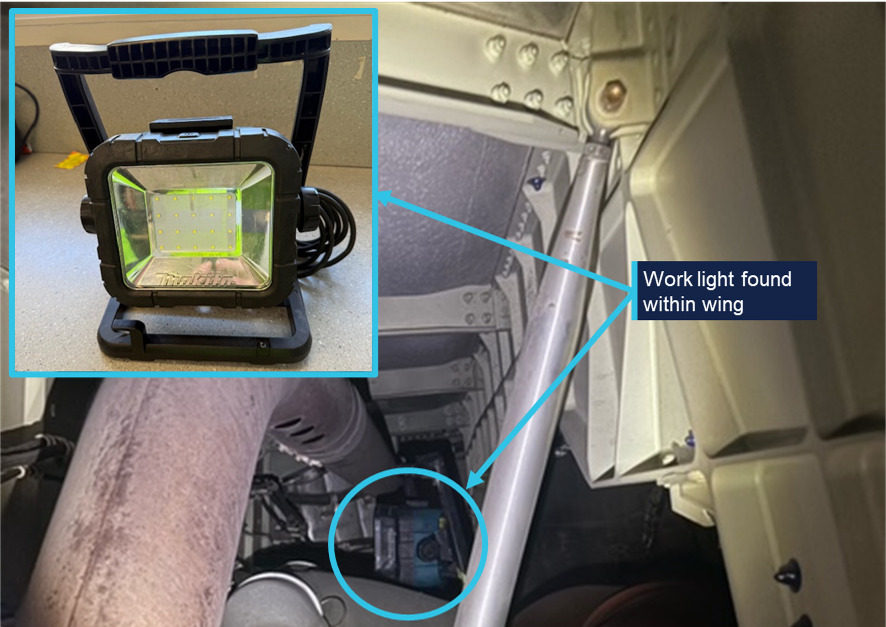
SYDNEY — A Qantas Airbus A380 completed a round-trip trans-Pacific crossing with a 33-centimeter maintenance light left inside its left wing, highlighting vulnerabilities in aviation tool-tracking systems, according to a report released by the Australian Transport Safety Bureau (ATSB).
The incident occurred following maintenance on the superjumbo’s air conditioning system at Sydney Airport on January 7, 2026. A Makita LED work light—measuring approximately 214 × 261 × 328 mm—was placed inside an access panel on the left wing’s inner leading edge to illuminate a cramped, hot workspace.
Upon completing the repair, engineers switched off the light and closed the access panel, leaving the tool inside. The double-decker aircraft (registration VH-OQK) was cleared for flight and subsequently completed two long-haul international passenger sectors, flying from Sydney to Dallas-Fort Worth and back—covering more than 27,000 kilometers—before the light was discovered and removed on January 9.
Systemic Breakdown Across Multiple Safety Defenses
The ATSB’s final investigation concluded that the incident resulted from a breakdown in foreign object debris (FOD) control and tool accountability procedures.
According to ATSB Chief Commissioner Angus Mitchell, three separate safety clearance checks failed to detect the missing equipment before the aircraft was released into passenger service:
- Foreign Object Clearance: Maintainers failed to spot the dark, switched-off light during their end-of-maintenance inspection in the confined wing cavity. High ambient temperatures (27–30 °C) and operational distractions reduced inspection effectiveness.
- Tool Return Checks: The light’s absence went unnoticed when engineers returned primary tools at the end of the shift, partly because the light was categorized as a passive illumination tool rather than a task-specific instrument.
- Maintenance Certification: A Licensed Aircraft Maintenance Engineer (LAME) issued a release to service without verifying the unreturned tool report, distracted by concurrent engine maintenance tasks and flight departure preparations.
Furthermore, the ATSB identified a critical software gap: Qantas’s maintenance management system lacked an automated alert to notify certifiers if a tool remained checked out under an aircraft’s registration prior to signing off the certificate of release to service.
“Even well-established processes can be vulnerable when they rely solely on consistent human performance, particularly during maintenance tasks conducted under operational pressures,” Commissioner Mitchell said. “Tool control systems must account for this variability with safeguards to detect and recover from errors.”
Safety Impact and Operator Response
While the forgotten work light caused no physical damage to the wing’s internal structures or mechanical systems, foreign object debris poses a significant hazard in commercial aviation. Loose items inside flight-critical structures can shift during turbulence or maneuvers, potentially jamming control mechanisms, damaging electrical wiring, or puncturing lines.
In response to the findings, Qantas has implemented several corrective safety measures:
- Mandatory Pre-Clearance Checks: Introducing mandatory verification procedures to ensure all logged tools are accounted for before maintenance sign-off.
- System Improvements: Enhancing software alerts within the maintenance database to flag unreturned tools automatically.
- Tooling Working Group: Establishing a dedicated team to explore new tracking technologies, including digital tool-tagging systems, across its maintenance bases.
This marks the second major tool-retention event involving a Qantas A380 in recent years. In December 2023, a 1.25-meter nylon turning tool was left inside an engine intake during maintenance in Los Angeles, remaining undetected across 34 flights before being discovered during a scheduled inspection in early 2024.
The ATSB noted that while Qantas’s post-incident safety directives are a positive step, continuous reinforcement of tool accountability is vital to prevent human error from compromising flight safety.