
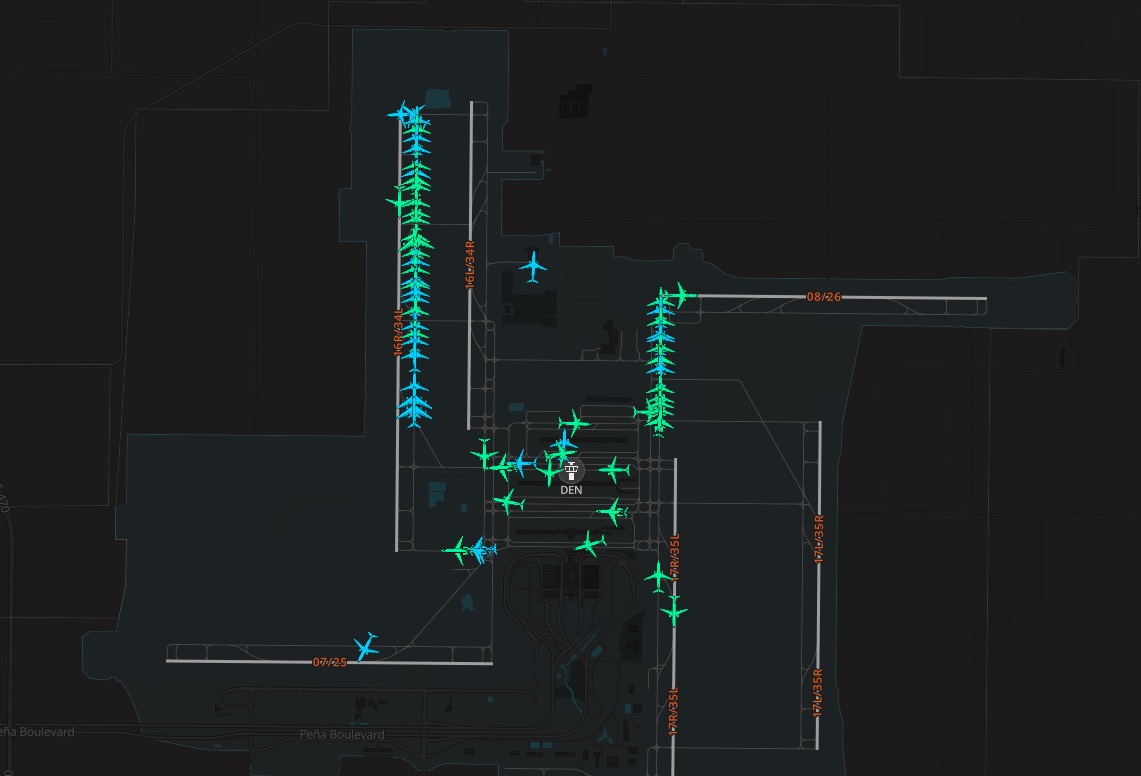
DENVER — A massive traffic jam has developed on the tarmac of Denver International Airport (DEN) as severe low cloud ceilings forced federal aviation regulators to slash the airport’s departure rates, leaving roughly 70 aircraft idling on taxiways waiting for a chance to take off.
The Federal Aviation Administration (FAA) issued an updated statement warning travelers that departures from the major Rocky Mountain hub are currently delayed by an average of 45 minutes, and that wait time is expected to climb.
A Drastic Reduction in Runway Capacity
The gridlock is being driven by “low ceilings”—a term used by meteorologists and air traffic controllers to describe dense, low-hanging cloud layers that heavily restrict visibility. When visibility drops below certain thresholds, pilots and controllers can no longer operate under visual flight rules (VFR) and must transition entirely to instrument flight rules (IFR). This requires increasing the spacing between aircraft for safety, which drastically slows down operations.
To handle the bottleneck, air traffic control has consolidated all departure traffic into just two runways: 16R (on the west side of the airfield) and 08 (running east-west).
Because Denver is a massive connecting hub for carriers like United Airlines and Southwest Airlines, a restriction like this triggers an immediate domino effect. Long lines of planes have formed across the airport’s taxiway network, looking less like an airfield and more like rush hour traffic on Interstate 70.
The Domino Effect for Passengers
With 70 planes trapped in line and average delays compounding past 45 minutes, thousands of passengers are stuck sitting on the tarmac or waiting at the gates. Aviation experts warn that afternoon delays of this magnitude often lead to cascading disruptions across the entire United States, as the planes stuck in Denver are desperately needed for later flights in other cities.
FAA Operational Notice: “Departures to Denver International Airport are experiencing volume and weather-related constraints. Passengers are strongly advised to check their flight status directly with their airline before heading to the terminal.”
Airport terminal officials are advising travelers already at DEN to monitor digital flight boards closely, as rolling gate changes and extended ground delays are likely to continue until the cloud deck breaks.