
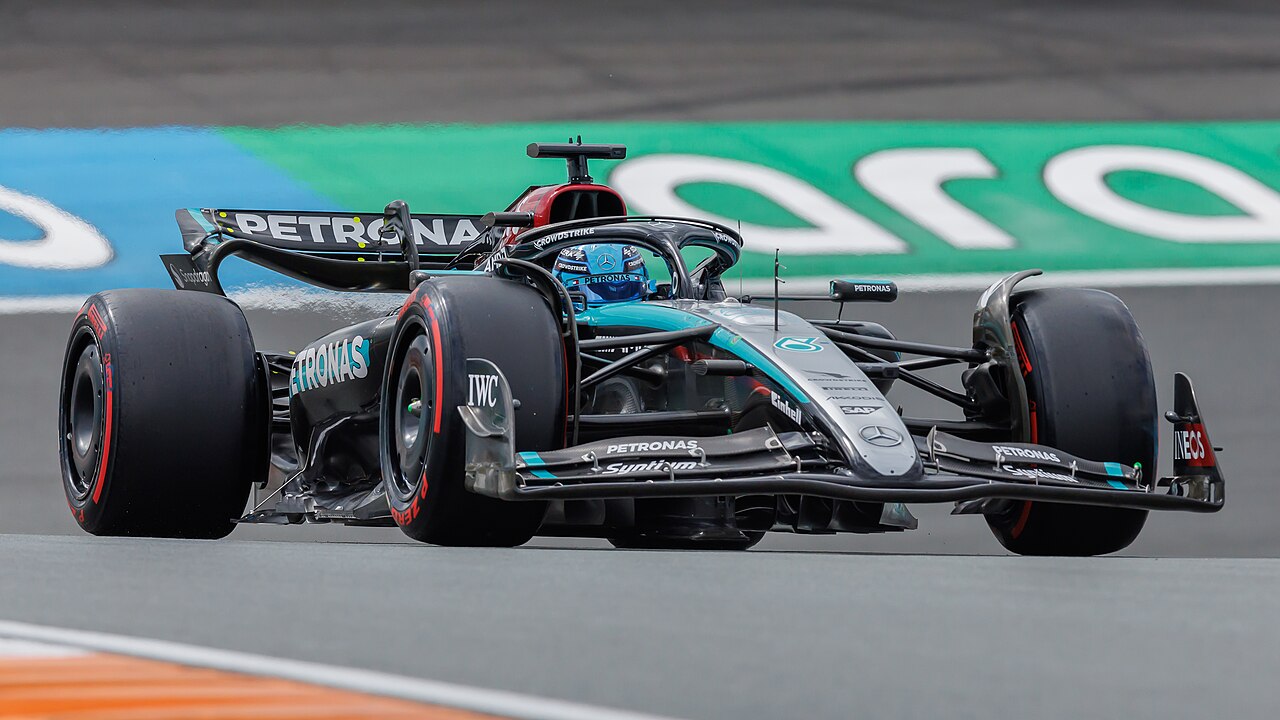
George Russell’s sudden retirement while fighting at the front of the Canadian Grand Prix has triggered an unprecedented logistical headache for the Mercedes-AMG Petronas F1 Team.
In a bizarre twist of international safety protocols, the Brackley-based squad will not be able to inspect the failed component at their high-tech UK headquarters for months, as international air freight laws have forced the team to send the volatile part back to Europe on a slow-moving cargo ship.
The British driver, who started from pole position and was locked in an intense battle for the lead, suffered a sudden and catastrophic failure of his ERS (Energy Recovery System) battery module on Lap 30. Telemetry data indicated an instant power shutdown, forcing Russell to steer his car onto the grass and out of the race, a massive blow to his world championship aspirations.
While a DNF (Did Not Finish) is painful enough, it is the post-race technical aftermath that has left senior team figures stunned.
Forbidden from the Skies
Under standard operating procedures, any failed or suspect component is immediately crated up and put onto one of the dedicated Formula 1 cargo planes or a commercial airliner bound for the UK just hours after the checkered flag.
However, because Russell’s lithium-ion battery suffered a severe internal thermal event, it instantly triggered strict international aviation safety laws.
According to strict regulations enforced by the International Air Transport Association (IATA) and the International Civil Aviation Organization (ICAO), damaged, defective, or unstable lithium batteries are strictly forbidden from air transport. Because these units pose a high risk of thermal runaway, toxic off-gassing, and intense fires that are incredibly difficult to suppress at 35,000 feet, no commercial airline or private air freight carrier can legally accept the cargo.
Mercedes Deputy Team Principal, Bradley Lord, confirmed the logistical nightmare during his post-race media debrief:
“It was a sudden sort of kill of the ERS system on the car, and then that did a reasonable amount of damage afterwards as well. We got the car back and were able to get the module out of it. It had to undergo some unusual safety procedures and then has to be shipped back actually to the UK. It will therefore be several months before the hardware gets back.”
The Marine Alternative
Because the aviation sector closed its doors, Mercedes had to execute “unusual safety procedures” on-site at the Circuit Gilles Villeneuve. The volatile battery module had to be cooled, chemically stabilized, and packed into a specialized, explosion-proof maritime shipping container.
Instead of a 24-hour flight back to the UK, the broken energy store is currently sitting in the hull of a container ship crossing the Atlantic Ocean.
This creates a massive bottleneck for Mercedes’ engineering division. While they have access to live telemetry recorded during the race, a true “forensic post-mortem” requires engineers to physically dismantle the cells, look at the microscopic fractures, and understand why the safety failsafes failed to prevent the damage.
Flying Blind Into the Next Rounds
With the European leg of the season in full swing, Mercedes’ technical department will be forced to operate in the dark. Without physical analysis of the hardware, engineers cannot definitively prove whether Russell’s failure was an isolated anomaly or a systemic design flaw that could threaten the power units of Lewis Hamilton or Mercedes’ customer teams (McLaren, Aston Martin, and Williams).
For now, Toto Wolff’s squad will have to rely entirely on digital simulations and telemetry data to prevent a repeat of the Montreal disaster, while the physical truth slowly sails across the ocean.