


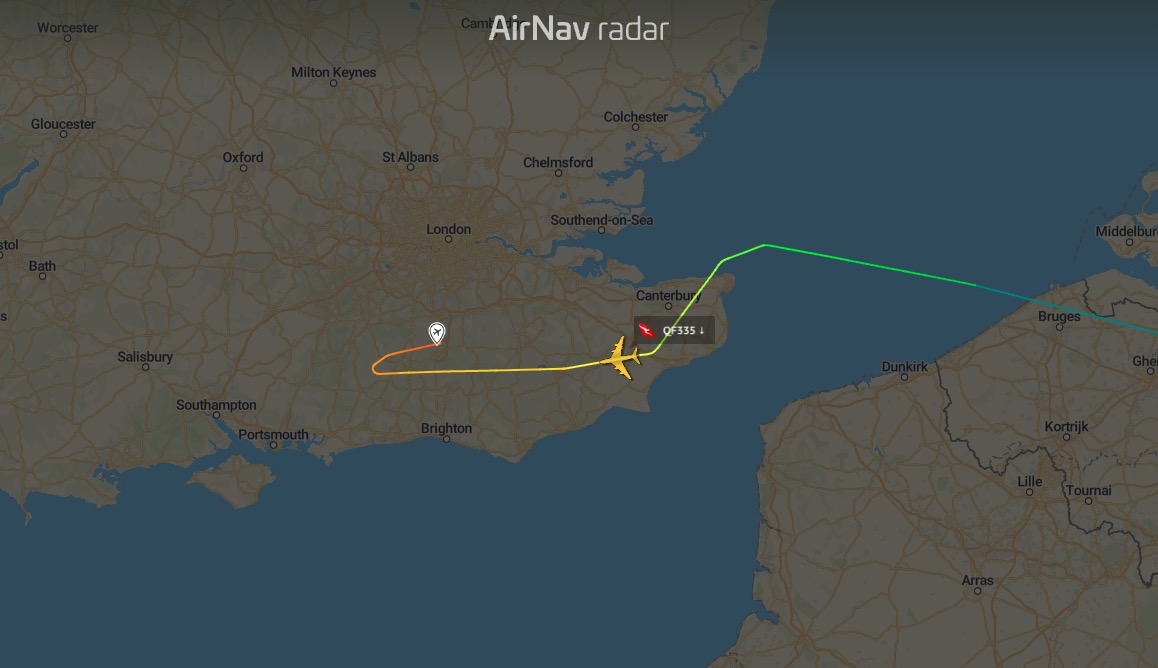
Aviation enthusiasts at London Gatwick were treated to a rare spectacle on Monday morning as a Qantas Airbus A380-800 touched down at the airport.
LONDON, UK — The double-decker aircraft, registered as VH-OQG and named Charles Ulm, arrived at 10:28 AM BST on April 20, 2026. The arrival marked the conclusion of a massive multi-leg journey that spanned two days and thousands of miles.
From Sydney to Sussex
The “Flying Kangaroo” didn’t take its typical scheduled path. The aircraft’s journey began on Sunday, April 19, departing Sydney (SYD) for a seven-hour hop to Singapore (SIN). After a brief layover, it embarked on the long-haul leg to London, clocking a flight time of 13 hours and 24 minutes.
While Qantas is a daily fixture at Heathrow (LHR) with its QF1/QF2 service, an A380 landing at Gatwick is an exceptionally unusual event.
Why Gatwick?
The appearance of the superjumbo at London’s secondary hub was not due to a diversion or weather emergency. Instead, the flight was confirmed to be an exclusive charter operation.
- The Quick Turnaround: In a display of operational efficiency, the aircraft remained on the Gatwick tarmac for just over three hours.
- Departure: After disembarking its charter passengers and refueling, the A380 departed Gatwick at 1:43 PM BST, reportedly heading back toward Singapore.
Technical Snapshot: VH-OQG
| Metric | Detail |
| Aircraft Model | Airbus A380-842 |
| Name | Charles Ulm |
| Flight Number | QF335 (Arrival) / QF336 (Departure) |
| Total Leg Time | ~21 hours (Sydney to London via Singapore) |
A Special Mission
While the specific nature of the charter remains private, industry insiders suggest such “one-off” Gatwick visits are often utilized for large-scale corporate events, government delegations, or exclusive cruise ship transfers.
The sight of the iconic red-and-white tail at Gatwick’s North Terminal provided a unique “avgeek” moment, as the A380 is rarely seen at the airport outside of emergency diversions or rare Emirates scheduled surges. By Monday evening, Charles Ulm was already well on its way back across the Eastern Hemisphere, leaving Gatwick’s runways to their usual short-haul traffic.