

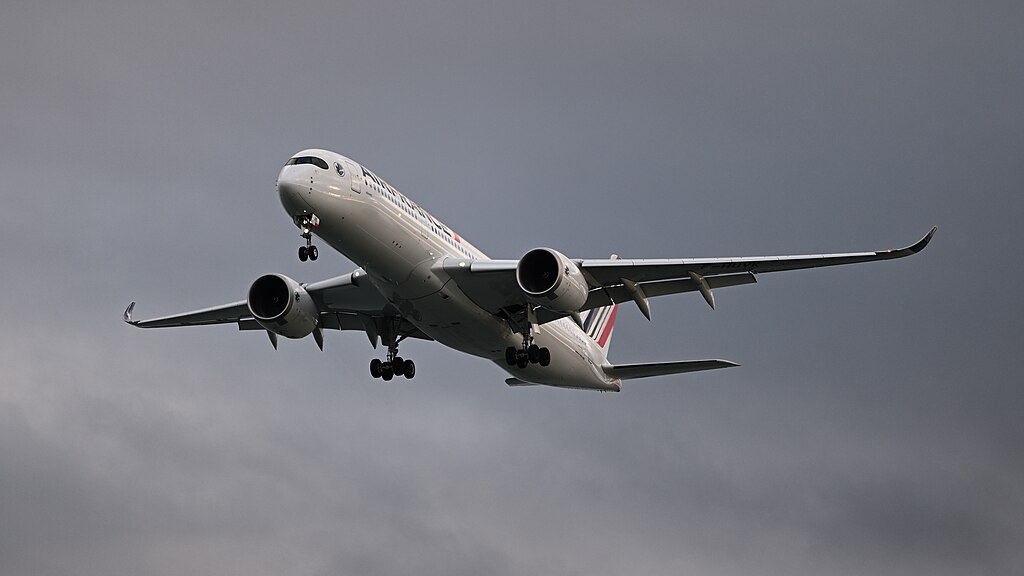
Air France pilots have raised serious concerns regarding the weather radar systems on the Airbus A350.
According to findings from the French Bureau of Enquiry and Analysis, the issue has come to light following a dramatic incident involving a flight from Osaka to Paris, revealing critical maintenance and structural vulnerabilities.
The Incident: A Serious Failure
The alarm was primarily triggered by an incident involving Air France flight AF291. Shortly after takeoff from Osaka, the crew of the Airbus A350 (registration F-HTYO) received multiple “WXR Fault” alerts, indicating a total failure of the weather radar.
Unbeknownst to the pilots, the aircraft’s radome—the “nose cone” that protects the radar antenna—had been structurally weakened by previous undetected bird strikes. As the plane climbed, the weakened composite material could no longer withstand the aerodynamic pressure. At 30,000 feet, the radome collapsed inward.
This structural failure caused a “cascading” emergency:
- Radar Loss: The collapsed cone physically crushed the radar antenna, leaving the pilots “blind” to weather conditions.
- Instrument Chaos: The deformed nose disrupted the airflow to the Pitot probes (airspeed sensors). This led to “unreliable airspeed” indications, forcing the pilots to fly the plane manually while dealing with conflicting data on their screens.
Why Pilots are Worried
The core of the concern, as highlighted by Le Parisien, is that these radar failures were not isolated. The investigation revealed that the specific aircraft had experienced recurring weather radar faults in the days leading up to the accident.
Pilots and safety investigators are highlighting several “critical and regular” failures:
- Invisible Damage: Composite materials used in modern aircraft like the A350 can suffer “delamination” (internal peeling) from bird strikes without showing any cracks or dents on the outside.
- Maintenance Gaps: In the Osaka case, maintenance teams had checked the radar and deemed it operational because it passed electronic tests. However, they failed to perform a physical internal inspection of the radome structure itself, which is required after bird strikes.
- Frequency of Faults: Pilots have noted that radar “fault” messages are becoming uncomfortably common, sometimes masking deeper structural issues that could lead to a repeat of the Osaka incident.
Corrective Measures
In response to these findings, both Airbus and Air France have taken steps to tighten safety protocols:
- Mandatory Inspections: Maintenance technicians are now required to systematically open and inspect the interior of the radome after any bird strike, lightning strike, or hail encounter, regardless of how the exterior looks.
- Updated Procedures: Airbus has revised the troubleshooting manuals for the A350 to ensure that recurring radar faults are treated as potential signs of structural damage rather than just electronic glitches.
- Pilot Training: Air France has reinforced training for its long-haul pilots on how to handle the specific “NAIADS” (data switching) logic of the A350 when sensors provide conflicting information.
Conclusion
The report serves as a wake-up call for the aviation industry regarding the maintenance of next-generation composite aircraft. While the A350 remains one of the most advanced jets in the sky, the “silent” degradation of its nose cone has forced a rethink of how airlines balance high-tech sensor data with old-fashioned physical inspections.
For now, Air France pilots remain vigilant, calling for stricter adherence to maintenance schedules to ensure a “fault” on the screen doesn’t turn into a structural failure in the air.