

A Lockheed C-130 large air tanker that impacted the ground following an aerial firefighting retardant drop likely aerodynamically stalled when flying in hazardous conditions that included windshear and an increasing tailwind, an ATSB investigation has found.
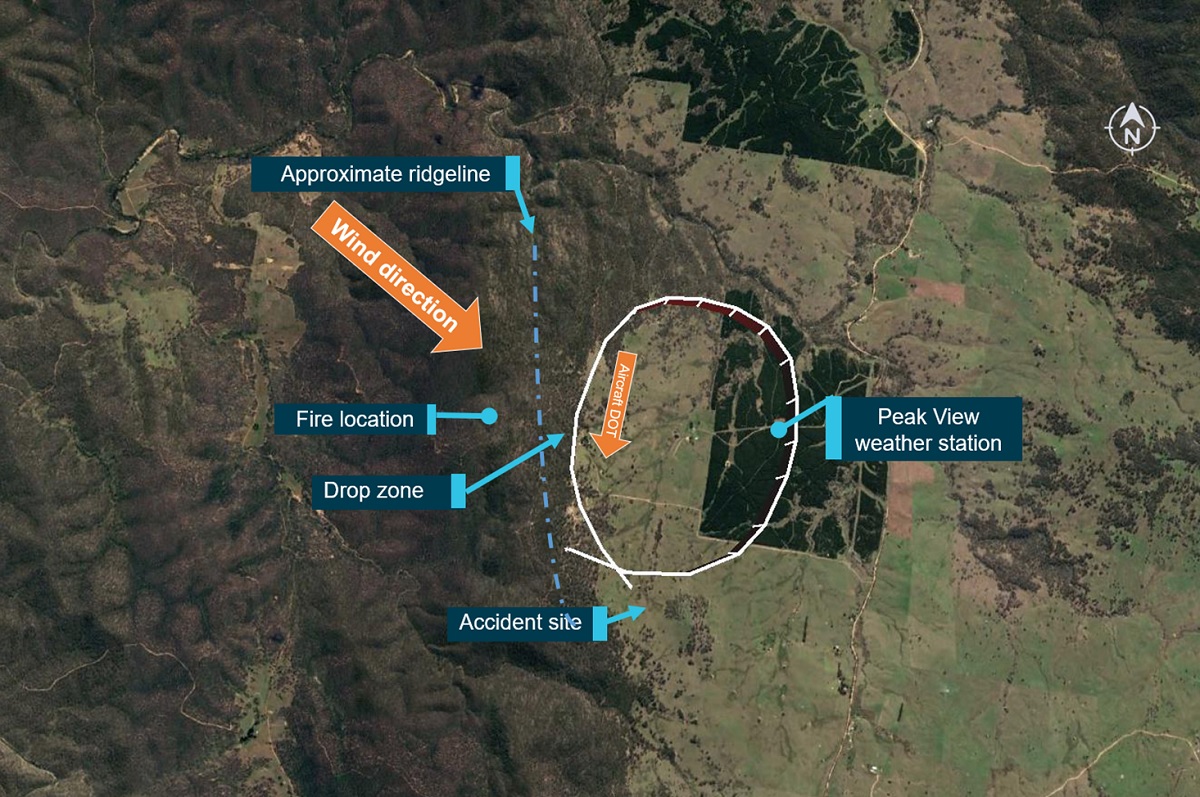
All three crew on board were fatally injured when the aircraft impacted slightly rising terrain while conducting a climbing left turn away from the drop site at the Good Good fire-ground near Peak View, north of Cooma, in the NSW Snowy Mountains region, on 23 January 2020.
Strong gusting winds and mountain wave activity, producing turbulence, were both forecast and present at the drop site. The fire and local terrain at the fire-ground likely exacerbated these hazardous conditions, the investigation report notes.
“The ATSB recognises the critical importance of aerial firefighting, where aircraft are flown at low altitudes and low airspeeds, often in challenging conditions, in the management and suppression of bushfires in Australia,” said ATSB Chief Commissioner Angus Mitchell.
“These operations necessarily take place in a high-risk environment, which requires a continued focus on risk mitigation, a responsibility that, in the Australian operating context, is shared between the tasking agency and the aircraft operator.
“As part of this investigation we have sought to understand the risk mitigations in place at the time of the accident, and have identified a number of safety issues that if resolved through actions will further mitigate risks for large air tanker aerial firefighting in the future.”
The investigation details that the C-130 was being operated by Coulson Aviation under contract to the New South Wales Rural Fire Service (RFS).
On the morning of the accident, the RFS State Operations Centre had tasked two large air tankers operating from RAAF Base Richmond, a Boeing 737 and the C-130, to conduct retardant drops at Adaminaby. The 737 departed first, and after conducting a drop at Adaminaby its crew reported that conditions precluded them from returning to the fire-ground.
The investigation notes that the RFS continued the C-130’s tasking to Adaminaby despite an awareness of the extreme environmental conditions and that all other fire‑control aircraft were not operating in the area at the time. (All smaller fire-control aircraft had ceased flying, a ‘birddog’ lead aircraft initially assigned to support the 737 and C-130 had declined the tasking, and the 737 was returning to Richmond, having declined further tasking to Adaminaby.)
This information was not communicated by the RFS to the C-130’s crew.
Instead, the ATSB notes that the RFS relied on the pilot in command to assess the appropriateness of the tasking to Adaminaby without providing them all the available information to make an informed decision on flight safety.
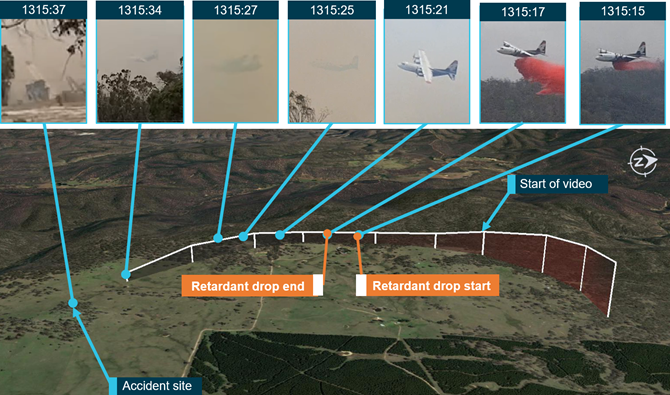
When the C-130 arrived overhead Adaminaby, the crew assessed the conditions were unsuitable and instead accepted an alternate tasking to the Good Good fire at Peak View, about 58 km to the east, which was subject to the same conditions.
Shortly after conducting a partial drop at Peak View, the aircraft commenced a climbing left turn. Following this, climb performance degraded and while at a low height and airspeed, it was likely the aircraft aerodynamically stalled, resulting in the collision with the ground.
The investigation notes that acceptance of the taskings was consistent with the operator’s practices to depart and assess the conditions to find a workable solution rather than rely solely on a weather forecast, which may not necessarily reflect the actual conditions at the fire-ground.
“The investigation found that Coulson Aviation’s safety risk management processes did not adequately manage the risks associated with large air tanker operations, in that there were no operational risk assessments conducted or a risk register maintained,” Mr Mitchell said.
“In addition, the operator did not provide a pre-flight risk assessment tool for their firefighting large air tanker crews. This would provide predefined criteria to ensure consistent and objective decision-making with accepting or rejecting tasks, and would take into account elements such as crew status, the operating environment, aircraft condition, and external pressures and factors.”
Separately, the RFS had limited large air tanker policies and procedures for aerial supervision requirements and no procedures for deployment without aerial supervision, the investigation found.
The RFS also did not have a policy or procedures in place to manage task rejections, nor to communicate this information internally or to other pilots working in the same area of operation.
“The responsibility for the safety of aerial firefighting operations has to be shared between the tasking agency and the aircraft operator,” Mr Mitchell said.
“This accident highlights the importance of having effective risk management processes, supported by robust operating procedures and training to support that shared responsibility.”
Mr Mitchell noted Coulson Aviation has taken proactive safety actions in response to the accident, including the introduction of a pre-flight risk assessment tool, a new three-tiered risk management approach, and windshear procedures and training.
Separately, the RFS has committed to undertake a comprehensive review of RFS aviation doctrine and undertake detailed research to identify best practice (nationally and internationally) relating to task rejection and aerial supervision policies and procedures as well as initial attack training and certification.
Mr Mitchell welcomed that commitment but noted the ATSB has issued three safety recommendations to the RFS to take further action to reduce the risk associated with three safety issues identified in the investigation. These concern managing and communicating task rejections, aerial supervision requirements, and initial attack certification.
The ATSB has also issued two safety recommendations to Coulson Aviation. These are to further consider the fitment of a windshear detection system to their C-130 aircraft, and to incorporate foreseeable external factors into their pre-flight assessment tool.