


Due to loss of power on both engine, a Boeing 777 from Beijing fell from the sky just hundreds of meters short of the runway.
LONDON – Today marks the 18th anniversary of one of the most remarkable displays of airmanship in modern aviation history: the crash-landing of British Airways Flight BA38 at London Heathrow Airport.
On January 17, 2008, a Boeing 777-200ER, arriving from Beijing, fell from the sky just hundreds of meters short of the runway. While the aircraft was destroyed, all 152 people on board survived, a feat widely credited to the split-second decisions of the flight crew.
The Final Seconds: “I Can’t Get Power”
The flight had been routine for over ten hours as it cruised over the frozen landscapes of Siberia and Scandinavia. However, as the aircraft descended through 720 feet on final approach to Runway 27L, disaster struck.
When the autothrottle commanded more power to maintain airspeed, the engines failed to respond. First Officer John Coward, who was the pilot flying, realized with horror that the engines had “rolled back” to near-idle speed.
“Pete, I can’t get power on the engines,” Coward reportedly told Captain Peter Burkill.
With the aircraft rapidly losing speed and gliding toward the perimeter fence and the busy A30 dual carriageway, the crew had seconds to act. Captain Burkill made the critical decision to retract the flaps by five degrees. This reduced drag and gave the heavy jet just enough extra “glide” to clear the perimeter fence and the landing light towers.
The Impact
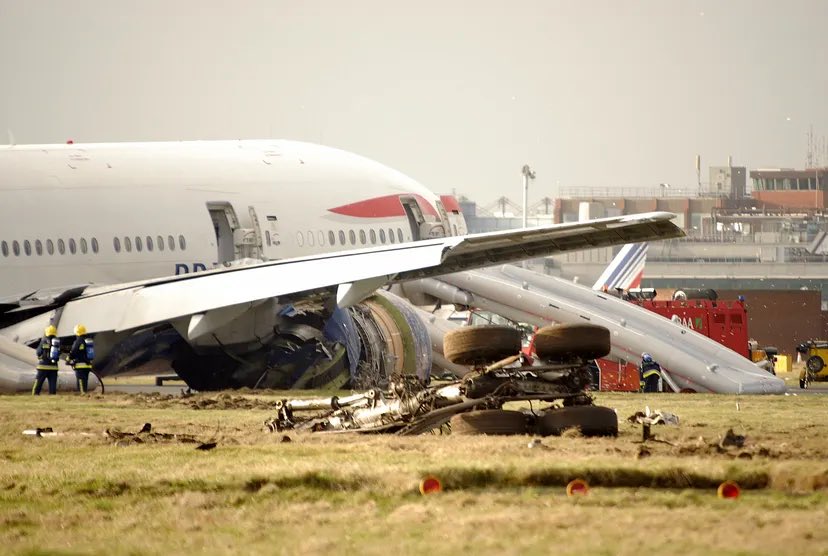
The 777 struck the grass about 270 meters short of the paved runway. The impact was violent:
- The nose gear collapsed immediately.
- The right main landing gear tore through the wing and punctured the fuselage.
- The aircraft skidded across the turf, eventually coming to rest on the very edge of the runway threshold.
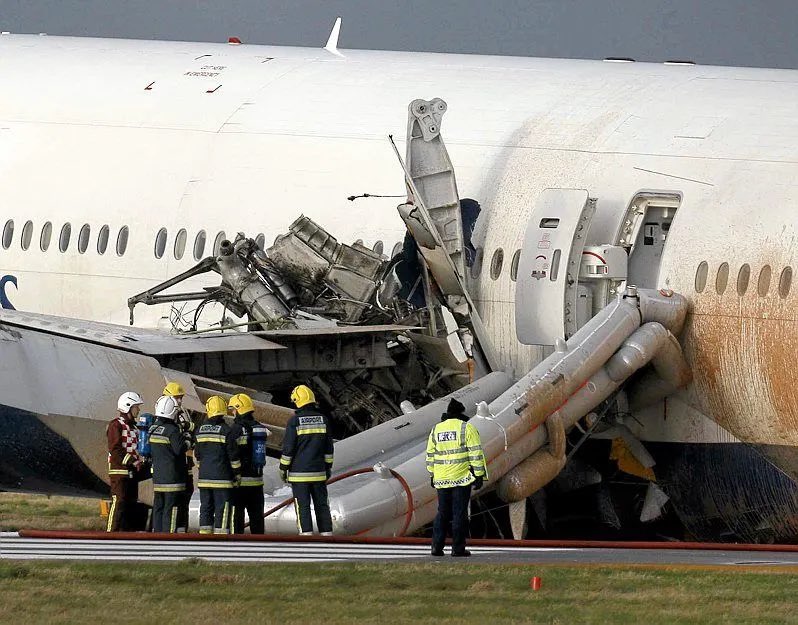
Despite a massive fuel leak from the ruptured tanks, no fire broke out. Emergency services were on the scene within seconds, and the cabin crew successfully evacuated all 136 passengers and 16 crew members. Only one passenger suffered a serious injury—a broken leg.
The Mystery of the Ice
The investigation by the Air Accidents Investigation Branch (AAIB) lasted two years and uncovered a “one-in-a-million” phenomenon.
Investigators found that during the long flight over cold regions, tiny ice crystals—formed from natural moisture in the jet fuel—had accumulated on the inside of the fuel lines. When the pilots demanded high thrust for landing, the increased fuel flow flushed this “soft ice” slush toward the engines, where it clogged the Fuel-Oil Heat Exchangers (FOHE). This essentially “starved” the engines of the fuel they needed to stay in the air.
Legacy and Safety
The crash of G-YMMM was the first hull loss of a Boeing 777, a model previously known for its near-perfect safety record.
The incident led to immediate global changes in aviation:
- Engine Redesign: Rolls-Royce modified the Trent 800 engines to ensure ice could not accumulate in the same way.
- New Procedures: Pilots were issued new guidelines for “stepping” through altitudes to keep fuel temperatures from staying in the “sticky range” for too long.
Today, eighteen years on, the “Miracle of BA38” remains a staple of pilot training—a testament to how human skill can turn a mechanical catastrophe into a story of survival.