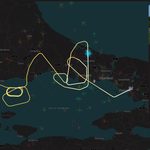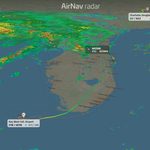



20 years ago today, Aeroperú Flight 603 (N52AW) was a scheduled flight from Miami International Airport, Florida to Comodoro Arturo Merino Benítez International Airport, Chile with stopovers in Ecuador and Peru. The Boeing 757-23A was carrying 61 passengers & 9 crew members.

N52AW, the aircraft involved in the accident seen at Miami International Airport in January 1996.
ACCIDENT

The cockpit crew consisted of Captain Eric Schreiber (Left), 58. Schreiber was a veteran pilot who had logged almost 22,000 flight hours. The First Officer was David Fernández (Right), 42. Fernández had logged almost 8,000 flight hours. Both were very experienced pilots.
On 1 October, Aeroperú Flight 603 from Miami International Airport had landed at Lima Airport using a Boeing 727-200 because of technical problems with the Boeing 757 that normally flew this route. 180 passengers were on the first leg of the flight. 119 had disembarked and the remaining passengers were transferred to the Boeing 757 after maintenance checks.
On 2 October at 12:42am Aeroperú Flight 603 took off from Lima-Jorge Chavez International Airport, Peru for a flight to Santiago-Arturo Merino Benitez Airport, Chile. Five minutes after takeoff the crew reported problems with their instruments and stated they wanted to return to the airport.

During the initial climb, the airspeed and altitude indications were too low. in calm winds, the windshear warning suddenly sounded. The aircraft climbed to FL130, before declaring an emergency and return to Lima was initiated. While returning the captain’s airspeed and altitude indications were too high, causing an overspeed warning. At the same time, the co-pilots airspeed indications were too low, triggering the stick shaker.


The air traffic controller had instructed a Boeing 707 to takeoff to help guide the 757 back in to land, but before the 707 could take off, the 757’s wingtip struck the water, approximately 25 minutes after the emergency declaring an emergency. The aircraft pulled up at about 200ft and crashed at a speed of 260 knots inverted. The captain’s airspeed indicated 450 knots and an altitude of 9500 ft. All 61 passengers & 9 crew members were killed.
INVESTIGATION
The investigation into the cause of the crash of Aeroperú Flight 603 was led by the Commission of Accident Investigations (CAI) & the National Transportation Safety Board (NTSB).

They concluded that the probable cause was the error of the maintenance staff including the crew. It can be deduced from the investigation carried out that the maintenance staff did not remove the protective adhesive tape from the static ports. The tape was applied before washing and polishing the aircraft prior to the accident flight. This tape was not detected during the various phrases of the aircraft’s release to the line mechanic.
It transferred to the passenger boarding apron and lastly the inspection by the crew responsible for the flight (the walk around or pre-flight check), which was carried out by the pilot-in-command according to the mechanic responsible for the aircraft on the day of the accident.
The pilot-in-command made a personal error by not complying with the procedure for GPWS alarms and not noticing the readings of the radio altimeters in order to discard everything which he believed to be fictitious. The co-pilot made a personal error by not being more insistent, assertive and convincing in alerting the pilot-in-command much more emphatically to the ground proximity alarms.
Final Report (Unofficial English translation)
Article By: @AirCrashMayday
Sources: AviationSafety, Wikipedia