
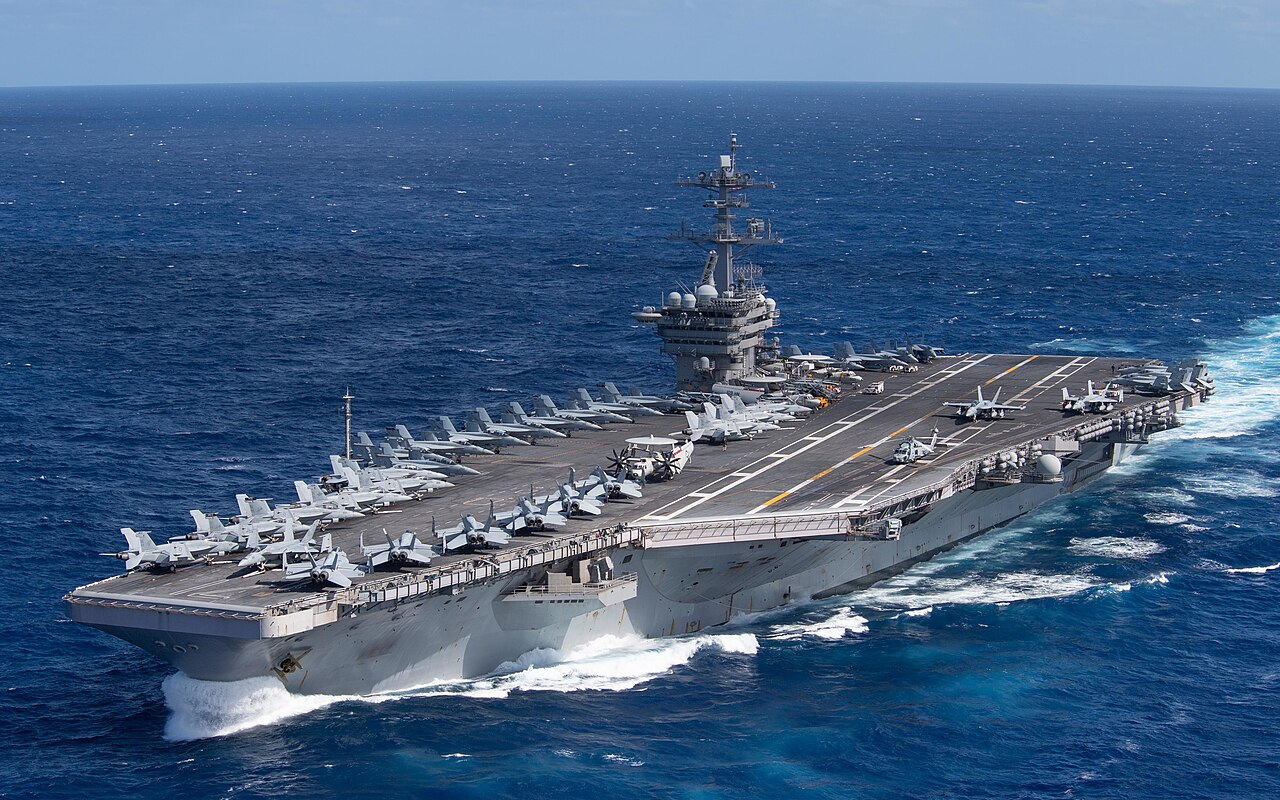
WASHINGTON — November 16, 2026 The United States has expanded its naval footprint in the Middle East with the arrival of the aircraft carrier USS Theodore Roosevelt in the U.S. Central Command (CENTCOM) area of responsibility. According to U.S. officials, the Nimitz-class warship entered the theater over the weekend, bringing the number of American carrier strike groups operating simultaneously in the region to three.
A Major Naval Convergence
The USS Theodore Roosevelt (CVN-71), a nuclear-powered Nimitz-class aircraft carrier capable of carrying roughly 60 to 70 aircraft alongside a full complement of guided-missile destroyers and cruisers, transited the Strait of Malacca after departing Singapore earlier this month. While the Pentagon and CENTCOM have not issued formal confirmation regarding the exact operational timeline, U.S. officials indicated that the Roosevelt was initially slated to relieve one of the vessels already on station.
For the time being, however, the Roosevelt joins two other carriers operating primarily in the Arabian Sea:
- USS George H.W. Bush: Deployed in the region since April as part of Carrier Strike Group 10, currently serving on an extended mission.
- USS George Washington: Normally forward-deployed to Japan, operating in the Middle East with Carrier Air Wing 5 since August.
Defense analysts note that the simultaneous presence of three carrier strike groups (a force posture last seen in April 2026) gives Washington substantial air and maritime strike capabilities, bolstered by roughly 200 land-based fighter aircraft, amphibious Marine units, and additional Patriot and THAAD missile defense batteries across the theater.
Deadlocked Diplomacy and Escalating Flashpoints
The naval reinforcement comes against the backdrop of the ongoing conflict between the United States, Israel, and Iran, which began with coordinated U.S.-Israeli strikes against Iranian nuclear and military sites in late February 2026.
Diplomatic efforts to reach a lasting settlement remain deadlocked:
- Stalled Negotiations: U.S. President Donald Trump recently removed Vice President JD Vance from peace negotiations and stated on social media that Washington no longer requires an agreement with Tehran. Meanwhile, The Times of Israel reports that President Trump has privately indicated he may hold off on major new offensive operations provided Tehran and the Iran-backed Houthis in Yemen avoid further provocations.
- Nuclear Oversight Rejected: Iranian officials have ruled out allowing international nuclear inspections to resume, deepening concerns over the status of Tehran’s nuclear program.
Maritime Incidents and Regional Strikes
Despite the absence of full-scale aerial bombardments in recent weeks, low-level hostilities and maritime disruptions have intensified across the Persian Gulf and surrounding waterways:
- Strait of Hormuz Disruptions: Iran’s Islamic Revolutionary Guard Corps (IRGC) reported via state media on Monday that two oil tankers struck mines in the Strait of Hormuz, part of a series of incidents over Sunday and Monday in which six vessels caught fire. Maritime security monitors confirmed that the Panama-flagged tanker ON PHOENIX sustained engine room damage from an unknown projectile off the coast of Oman, though all crew members were reported safe. To counter Iranian pressure, CENTCOM recently established “Task Force Iron Gate” to enforce a maritime and land blockade restricting IRGC supply routes.
- Attacks in Bahrain: Tensions flared further on Sunday when Iran launched drone attacks targeting a U.S. military facility in Bahrain—its first direct strike on a Persian Gulf state in weeks. While the IRGC claimed to have destroyed a U.S. early warning radar, CENTCOM stated that American forces intercepted the incoming drones. Following the incident, the U.S. Embassy in Bahrain issued security alerts warning citizens of potential further attacks by Houthi militants.
While the U.S. military has dismissed recent Israeli media reports suggesting an imminent resumption of large-scale bombing campaigns as “pure speculation,” the convergence of three carrier strike groups underscores a heightened state of readiness as regional tensions persist.