
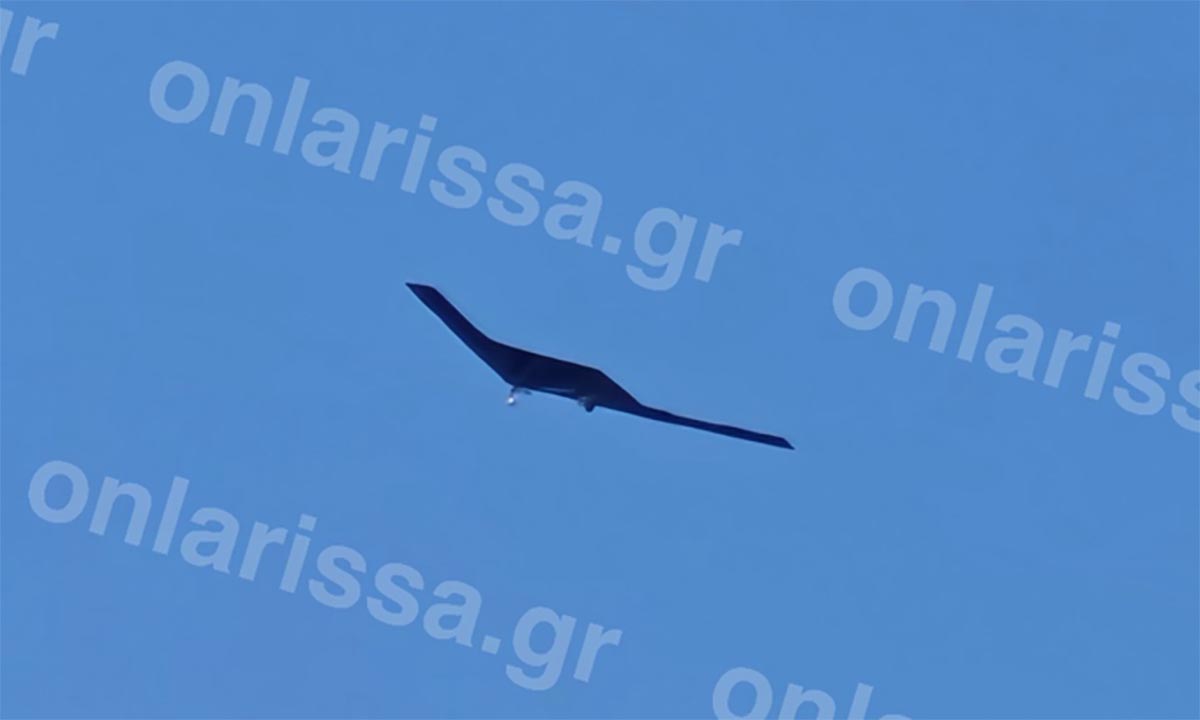
LARISSA, GREECE — Residents and military observers near the 110th Combat Wing were left “speechless” this week after a rare, bat-like stealth aircraft made an unscheduled emergency landing at Larissa National Airport.
While initial local reports from onlarissa.gr identified the aircraft as a B-2 Spirit stealth bomber, the incident has sparked intense debate among defense analysts. Recent photographic evidence suggests the “mysterious guest” may actually be the ultra-secretive RQ-180—a high-altitude, long-range stealth drone—or a similar “flying wing” prototype.
According to military sources, the aircraft was forced to land following a technical failure during operations in the region. The high-value asset currently remains grounded under heavy security at the 110th Fighter Wing, where it will undergo specialized repairs before attempting to depart.
Why “Any” Runway Won’t Do: The B-2’s Selective Needs
The emergency landing in Larissa is a significant event because stealth bombers like the B-2 Spirit—and their drone counterparts—cannot simply “pull over” at any civilian or military airport. Their design and technology impose strict requirements on where they can safely operate.
1. The Delicate Skin (Stealth Coatings)
The B-2 is covered in Radar-Absorbent Material (RAM), a complex cocktail of polymers and coatings that “trap” radar waves. This material is incredibly sensitive to:
- Humidity and Temperature: To maintain its “invisibility,” the B-2 traditionally requires climate-controlled hangars. Prolonged exposure to the wrong environment can degrade the stealth skin.
- Specialized Repair: If the “technical failure” involves the aircraft’s exterior, it requires specialized chemical cures and clean-room conditions that are only available at select “stealth-capable” bases.
2. Physical Footprint and Weight
With a massive 172-foot wingspan (nearly 53 meters), the B-2 is wider than it is long.
- Taxiway Width: Many standard fighter bases have taxiways that are too narrow, risking the bomber’s wingtips clipping signs, lights, or other aircraft.
- Pavement Strength: Fully loaded, a B-2 weighs over 330,000 lbs. It requires “heavy-load” runways with specific concrete thickness (PCN – Pavement Classification Number) to prevent the landing gear from literally sinking into or cracking the tarmac.
3. Logistic “Footprint”
A B-2 doesn’t travel alone. For a planned deployment, the Air Force must fly in:
- Extra Large Deployable Aircraft Hangar Systems (ELADS): Massive portable tents to protect the stealth coating.
- Specialized Ground Power: The B-2’s internal systems require specific electrical frequencies and cooling air that standard airport tugs often cannot provide.
4. Security and Secrecy
Because of its billion-dollar price tag and classified technology, the B-2 requires a Level 1 Security environment. This means a base must have the “manpower and masonry” to set up an immediate restricted perimeter, often excluding local personnel from the immediate vicinity of the aircraft.
What Happens Now?
The fact that the aircraft landed at Larissa Air Base—a facility that has recently seen upgrades to support U.S. MQ-9 Reaper operations—suggests the base had just enough infrastructure to handle the emergency. However, until a specialized “Recovery Team” arrives with the necessary tools and spare parts from the United States, one of the world’s most advanced pieces of technology will remain a very visible, very grounded guest in the heart of Greece.