
French aviation safety investigators have released a preliminary report revealing that a Nouvelair Airbus A320 flew directly over an EasyJet aircraft on September 21, 2025, in a wrong-runway near-collision at Nice.
The Bureau d’Enquêtes et d’Analyses (BEA) preliminary report documents one of the closest calls in European aviation history, where the Nouvelair flight from Tunis lined up with the wrong parallel runway at night in poor weather, descended to within feet of a departing aircraft, and pulled up only after overflying the EasyJet plane positioned for takeoff.
The incident involved 346 people total: the Nouvelair A320 (TS-INP) carried 176 passengers and 8 crew, while the EasyJet A320 (OE-IJZ) held 170 passengers and 8 crew. Both aircraft were fully loaded commercial flights operating in normal scheduled service when they came within seconds of a catastrophic collision.
Night Visual Approach in Deteriorating Weather
The incident occurred around 21:30 (9:30 p.m. local time) on September 21, 2025, during aeronautical night with deteriorating weather conditions. Weather information showed scattered clouds at 1,600 feet, broken clouds at 9,000 and 14,000 feet, with visibility of 10 kilometers, though conditions worsened during the approach.
METAR reports document moderate showers appearing between 21:30 and 21:40, with visibility decreasing to 2,800 meters by 21:34—just minutes after the near-collision. A SIGMET was active for the Marseille FIR warning of frequent thunderstorms with tops to FL420.
Convective Clouds Force Shortened Approach
The Nouvelair crew, observing convective weather on their radar around the LEMPU intermediate fix for the standard RNP Z 04L approach, requested the shorter RNP A 04L approach at 21:19. This shortened procedure allowed them to avoid cumulative clouds displayed on their weather radar west of the airport.
Two previous flights—operated by Tunisair (landing at 21:19) and Lufthansa (landing at 21:27)—had made the same request and successfully completed RNP A approaches to runway 04L due to the adverse weather in the standard approach path.
Correct Clearances, Deadly Confusion
At 21:25, the Nice tower/approach controller cleared the Nouvelair crew to start the RNP A approach to runway 04L after BISBO. The crew read back the clearance correctly. At 21:30, the controller cleared them to land on runway 04L, which the crew again acknowledged correctly.
Despite these correct clearances and read-backs, the crew would align with runway 04R—the wrong parallel runway designated for departures—in what represents a catastrophic breakdown in situational awareness during the visual portion of the approach.
The RNP A approach to runway 04 is a non-precision approach where crews fly instrument guidance to the Missed Approach Point (MAPt) at MN04A at 2,000 feet. If they have the runway in sight at MN04A, they then fly the VPT A (Visual Pattern) procedure, which requires a visual right turn from heading 354° to heading 043° to align with either runway 04L or 04R depending on which is designated for landing.
This procedure is identical up to MN04A whether landing on 04L or 04R—the visual turn after the missed approach point determines the landing runway. On September 21, runway 04L was designated for landings and 04R for takeoffs, following Nice’s standard segregated runway operations.
Critical Moments: Visual Descent Begins
At 21:30, the Nouvelair A320 passed MN04A at 2,000 feet in descent following a heading of 357°. The pilot flying (PF) disengaged the autopilot as required for the visual approach. The PF reported having the runway in sight.
Thirty seconds later, the PF began a right turn from heading 360° toward 040°. At 21:30:53, the aircraft descended through 1,000 feet at 138 knots with a 1,100 feet per minute descent rate, on a heading of 015° in the right turn, positioned 3.4 nautical miles from the threshold of runway 04R.
By 21:31:36, the Nouvelair A320 was fully aligned with runway 04R—the wrong runway—descending through 527 feet at 1.8 nautical miles from the threshold.
EasyJet Lines Up on Same Runway
While the Nouvelair flight was on final approach, the EasyJet crew operating flight to Nantes had been cleared to taxi, hold short of runway 04L, then cross 04L and proceed to holding point W3 on runway 04R for departure.
At 21:27, the tower controller cleared the EasyJet crew to line up on runway 04R and hold. The crew declined, requesting to wait at W3 because the cabin was not ready. At 21:30:53—the exact moment Nouvelair descended through 1,000 feet—the EasyJet crew reported ready for departure at holding point W3.
At 21:30:58, the controller cleared EasyJet to line up on runway 04R and hold. The crew read back correctly and began entering the runway.
Safety Systems Activate—Too Late
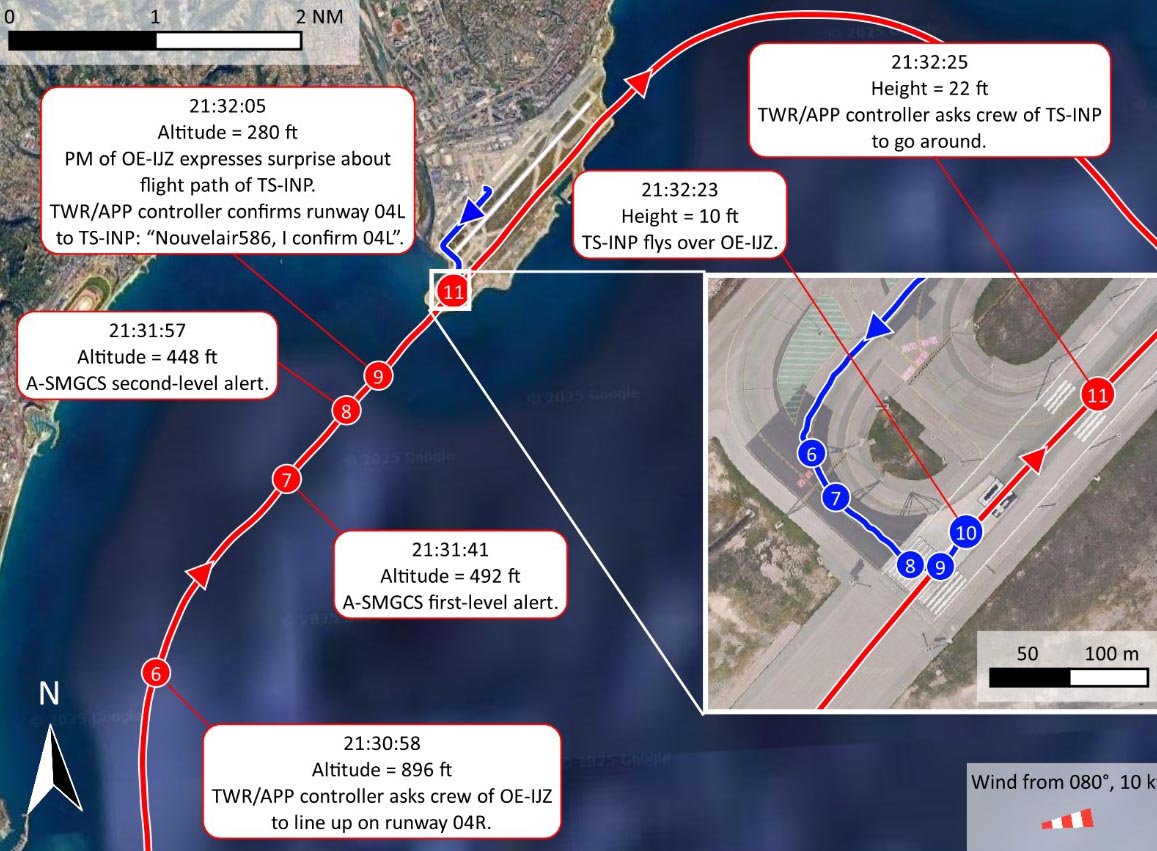
At 21:31:41, the first alert level (amber) of the A-SMGCS (Advanced Surface Movement Guidance and Control System) runway incursion system activated in the control tower when EasyJet entered runway 04R. At this moment, Nouvelair was at 492 feet descending at approximately 1.6 nautical miles from the threshold.
At 21:31:57—just 16 seconds later—the second alert level (red visual and aural warning) activated. Nouvelair was now at 448 feet in descent at approximately 1 nautical mile from the threshold, descending at 1,200 feet per minute with an indicated airspeed of 141 knots.
At 21:32:05, with EasyJet completing its turn onto the runway centerline, the tower controller contacted Nouvelair: “Nouvelair 586, I confirm 04L.”
The crew responded: “Short final 04L.”
The controller again cleared them: “Clear to land 04L.”
During this 18-second exchange, the aircraft descended from 258 feet to 158 feet, continuing its approach. The automated height callouts—100, 50, 40, and 30 feet—activated in rapid succession in the Nouvelair cockpit.
At 21:32:05, as EasyJet completed lining up on runway 04R, the first officer (PM) saw the Nouvelair aircraft on final approach. He expressed surprise at the perceived flight path.
However, critically, the EasyJet crew did not identify any conflict. They apparently assumed the approaching aircraft was landing on the parallel runway 04L as per normal operations, not recognizing that it was actually descending directly toward their position on 04R.
At 21:32:23, the Nouvelair A320 flew over the EasyJet A320 stopped and aligned on the centerline of runway 04R.
The BEA report documents the horrifying proximity: “The TS-INP radio altitude value dropped from 39 feet to 10 feet in one second before rising to 24 feet in the following second.”
This variation in radio-altimeter height corresponds to the Nouvelair aircraft flying over the EasyJet aircraft—the radio altimeter briefly read the height above the EasyJet fuselage rather than the runway surface, indicating vertical separation of approximately 25 feet or less.
At 21:32:25—just two seconds after the overflight—the tower controller ordered: “Nouvelair 586, go around.”
The 20-foot and “retard” automated callouts were activating in the Nouvelair cockpit at this moment. The crew executed the missed approach procedure. Recorded data confirms the main landing gear never touched runway 04R.
The go-around instruction came after the near-collision had already occurred, not in time to prevent the overflight.
Just 42 seconds elapsed from the first safety warning to the overflight—barely enough time for the controller to query the crew, receive their incorrect confirmation, and issue the go-around order that came too late to prevent the near-collision.
Runway Lighting Disparity
The BEA report identifies a critical factor: the two parallel runways have significantly different lighting systems and brightness levels that may have contributed to the confusion.
Runway 04L uses THORN halogen bulbs at brightness level 1 (minimum of four available levels). The PAPI lights are spaced just 4 meters apart instead of the standard 9 meters to reduce visual range to 7 kilometers due to environmental constraints.
Runway 04R, however, has been equipped since April 2022 with OCEM LED bulbs. At night, runway 04R lights are described in the report as “much brighter than the 04L runway lights.”
Additionally, at the time of the incident, runway 04R’s PAPI, threshold lights, wing bar lights, and threshold identification flashing lights were all extinguished since it was being used only for departures. Only the edge and centerline lights were illuminated at brightness level 1.
The report includes a photograph from a night approach showing the stark visual difference between the dimly-lit 04L and the brighter 04R, though it notes the image date and brightness levels are not confirmed.
No ILS Glideslope Available
The ILS glideslope for runway 04L had been out of service since April 30, 2025, with a NOTAM published. This meant pilots could not use instrument vertical guidance to verify their alignment with 04L during the approach—they were flying purely visual after passing the missed approach point.
The absence of the glideslope removed one potential tool that might have alerted the crew that they were not properly aligned with their assigned landing runway.
Experienced Crews on Both Aircraft
The incident involved highly experienced flight crews:
Nouvelair Captain (PF):
- Male, 55 years old
- ATPL issued 2009
- 15,180 total flight hours
- 273 hours in last 90 days
Nouvelair First Officer (PM):
- Male, 50 years old
- CPL issued 2011
- 4,250 total flight hours
EasyJet Captain (PF):
- Male, 53 years old
- ATPL issued 2009
- 16,000 total flight hours
EasyJet First Officer (PM):
- Male, 25 years old
- CPL issued 2023
- 1,019 total flight hours (recently qualified)
The incident did not involve inexperienced pilots—three of the four pilots held Airline Transport Pilot Licenses with thousands of hours of experience.
Controller Workload
The Nice tower was operating with four personnel:
- Tower supervisor
- RAMP/GND controller (combined positions)
- TWR/APP controller (combined positions)
- One controller on break
The TWR/APP controller was handling both tower and approach control simultaneously—a configuration permitted by the operations manual but representing significant workload during busy periods with marginal weather.
Similar Previous Incidents
The BEA report notes: “The BEA is aware of other incidents in which crews may have confused runways 04L and 04R, as well as runways 22R and 22L. The collection and study of these previous cases is ongoing.”
The French Air Navigation Service Provider (DSNA) immediately suspended visual approaches at night when both runways are in use as a precautionary measure. This prohibition eliminates the specific procedural combination that led to the near-collision.