

Is a 8 hour-flight over Atlantic more dangerous than a full day in the vicinity of the reactor number 4 of Chernobyl nuclear plant?
When most people think of radiation, dramatic images of nuclear disasters like Chernobyl come to mind—not commercial air travel. But long-haul flights, such as a transatlantic crossing, expose passengers to ionizing radiation like inside the Chernobyl Exclusion Zone.
The Earth’s atmosphere and magnetic field protect us from cosmic radiation. When you fly at high altitudes, especially near the poles (like many transatlantic routes), you’re closer to space and the protective shield is weaker—hence, greater exposure.
Transatlantic Flight (e.g., New York to London)
Passengers and crew flying at altitudes around 35,000 feet are exposed to increased cosmic radiation due to the thinner atmosphere at cruising altitude. A single 7–8 hour flight can expose you to approximately 0.03 to 0.08 millisieverts (mSv) of radiation, depending on factors such as altitude, latitude, solar activity, and flight duration.
Chernobyl Exclusion Zone (one day)
Contrary to popular belief, a short, controlled visit to the Chernobyl Exclusion Zone—especially areas like Pripyat or the vicinity of the reactor from a safe distance—results in relatively low radiation exposure. Tourists typically receive about 0.002 to 0.01 mSv for a full-day visit.
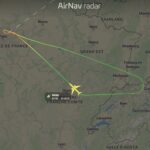
A passenger published a video showing measurement taken on a trans-atlantic flight from Paris to Toronto at 39,000 feet showing 336 μR/h meaning 0.0034 mSv/h so a total of 0.027 mSv for a 8-hour flight!
So yes, you are likely to receive more radiation from a single transatlantic flight than from spending a day in the Chernobyl Exclusion Zone under guided conditions.
Should we be worried?
Not really. For perspective:
- A dental X-ray exposes you to around 0.01 mSv.
- The average annual background radiation dose is around 2 to 3 mSv.
- A CT scan of the abdomen can expose you to about 10 mSv.
But some high-frequency long-haul flyers can get 3–5 mSv per year, or more depending on flight routes, altitude, and solar activity.
How much radiation do flight attendants get?
Over a full career (20–30 years), a flight attendant may accumulate 60 to 160 mSv of cosmic radiation during their whole career.
The International Agency for Research on Cancer (IARC) classifies cosmic radiation as a Group 1 carcinogen (known to cause cancer). Studies have shown slightly higher rates of certain cancers (e.g. breast cancer, melanoma) in flight attendants, although multiple factors (like circadian disruption, lifestyle, altitude) may contribute.
Airlines and agencies in Europe (EASA) and some others track cumulative exposure for flight crew. Pregnant flight attendants are usually grounded or reassigned to lower-exposure routes.