

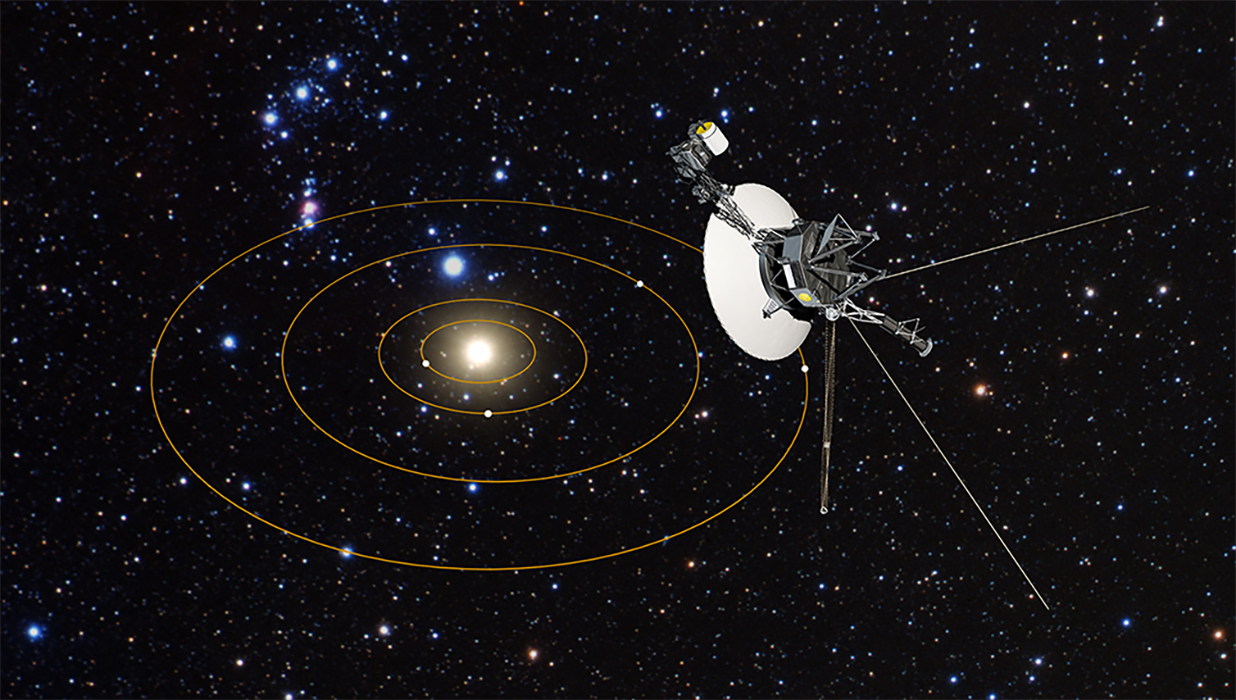
On Wednesday morning, NASA’s Voyager 1 spacecraft crossed a profound cosmic threshold: one full light-day away from Earth.
At exactly 5:16 a.m. EST on Nov. 18, the veteran probe—launched nearly five decades ago in 1977—reached a distance of roughly 16 billion miles (26 billion kilometers) from home. At that immense remove, even radio waves traveling at the speed of light require a full 24 hours to bridge the gap. For mission controllers, any command sent to the spacecraft now takes a day to arrive, and any confirmation or data takes another full day to return—creating a 48-hour round-trip conversation across the cosmos.
Since crossing into interstellar space in August 2012, Voyager 1 has held the title of the most distant human-made object. Yet, maintaining contact with a machine operating so far beyond the solar system requires an extraordinary feat of engineering, as the spacecraft whispers back to Earth using a transmitter with roughly the same power as an ordinary refrigerator light bulb. By the time that faint radio signal crosses the 16-billion-mile void, it arrives at Earth with a strength of just one-tenth of a billionth-trillionth of a watt.
To catch that whisper, NASA relies on its Deep Space Network, a global array of giant radio antennas located in California, Madrid, and Canberra, Australia. Using massive dishes measuring up to 230 feet (70 meters) across—and often linking multiple antennas together simultaneously to boost sensitivity—engineers manage to pull in Voyager 1’s science data at a trickle of 160 bits per second.
Keeping the aging explorer alive is a constant battle against diminishing power. Voyager 1 is powered by radioisotope thermoelectric generators that produced roughly 470 watts at launch, but lose about 4 watts of output every year as their plutonium fuel decays. To conserve energy and keep the spacecraft functioning, NASA engineers have had to make difficult choices, shutting down two of Voyager 1’s science instruments in recent years.
The challenges of operating 1970s hardware in the freezing expanse of interstellar space were underscored just last month. In October, Voyager 1’s signal unexpectedly vanished during two scheduled communication passes, sparking concern among flight controllers. Fortunately, before engineers even had a chance to send troubleshooting commands into the dark, the spacecraft’s signal reappeared on its own on Oct. 20.
To mark the historic light-day milestone, NASA invited skywatchers around the world to participate in a symbolic gesture on Tuesday evening, Nov. 17. After sunset, stargazers were encouraged to step outside and shine a flashlight toward the night sky, blinking out the letters “V-G-R” in Morse code—a silent, earthly tribute to humanity’s furthest emissary, traveling at the speed of light toward a spacecraft that continues to carry our message into the stars.